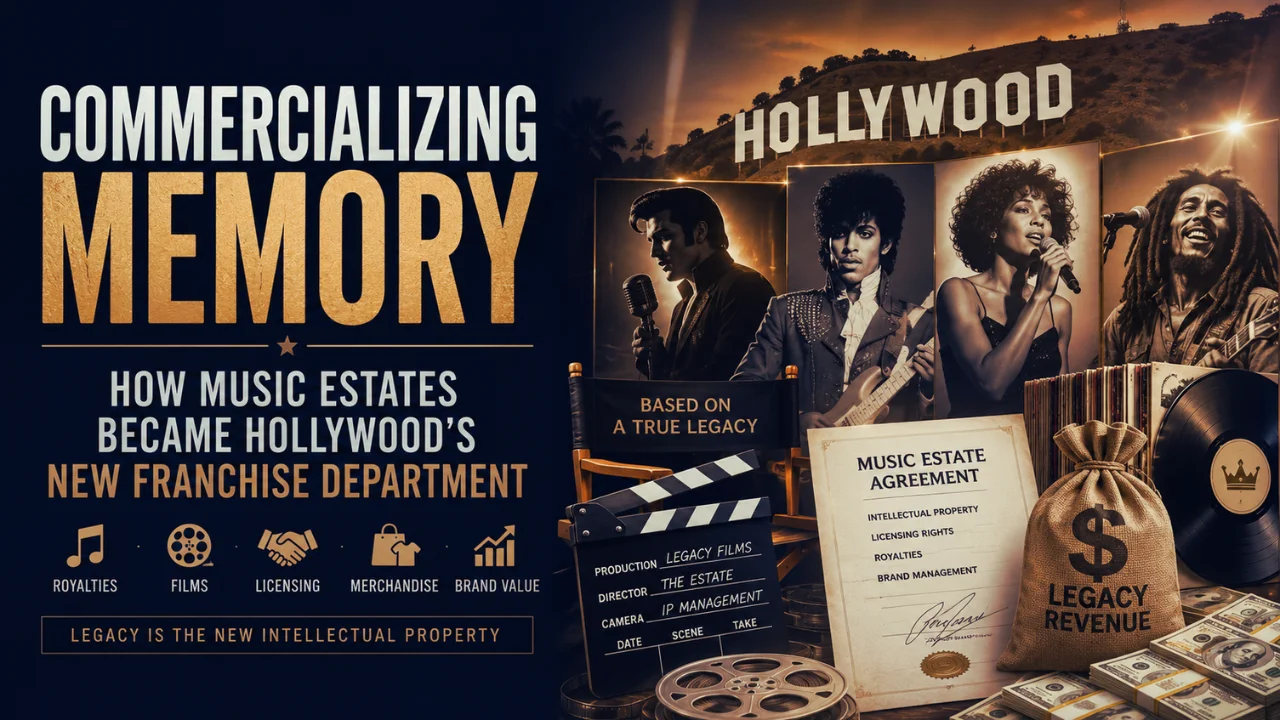
Commercializing Memory Through Music Estates
Hollywood has always loved familiar intellectual property. Superheroes, toy brands, and bestselling novels have dominated studio strategies for years. Now, another asset class has entered the franchise era: dead musicians.
The business of commercializing memory has become one of the most fascinating shifts in modern entertainment. Music estates are no longer simply preserving legacies. They are developing films, approving streaming projects, negotiating licensing deals, managing social media brands, and partnering with investment firms to create long-term revenue streams.
For readers interested in celebrity wealth and the entertainment business, this trend offers a revealing look at how fame continues generating income long after an artist’s final performance. It also shows why traditional celebrity net worth estimates rarely capture the full economic value of a cultural icon’s intellectual property.
Why This Celebrity Wealth Trend Matters Now?
Three forces have converged.
First, streaming has made music catalogs more predictable financial assets. Second, Hollywood is facing an ongoing demand for recognizable intellectual property. Third, institutional investors increasingly view music rights as a legitimate asset class.
The result is a new ecosystem where music estates operate like miniature media companies.
A generation that grew up with Michael Jackson, Whitney Houston, Prince, and Bob Marley is introducing that music to younger audiences through biopics, documentaries, Broadway productions, and social media. Hollywood sees audience familiarity. Estates see recurring revenue. Investors see cash flow.
Recent deals underline the point. The Michael Jackson estate has participated in film and catalog transactions worth hundreds of millions of pounds in reported value over time, while companies such as Primary Wave and HarbourView continue partnering with estates to expand their commercial reach.
What was once estate management increasingly resembles franchise management.
The Business Model Behind the Money
Music estates generate income from multiple channels simultaneously.
| Wealth Driver | How It Works | Why It Matters |
|---|---|---|
| Royalties | Payments from streams, radio, and sales | Creates recurring income |
| Licensing | Music used in films, ads, and games | Extends audience reach |
| Biopics | Revenue participation and promotional impact | Revives cultural relevance |
| Merchandise | Apparel, collectibles, and memorabilia | Expands brand monetization |
| Publishing Rights | Ownership of compositions | Long-term financial asset |
| Name and Likeness | Commercial use of image and identity | Creates new licensing opportunities |
Unlike a traditional inheritance, a music estate often functions like an operating business.
Executors, lawyers, investment firms, and entertainment executives regularly collaborate on decisions involving intellectual property, distribution, and brand strategy.
Salary Versus Ownership
Most celebrities earn income during their lifetime through performances, tours, endorsement deals, or acting salaries.
Music estates are different.
Their value comes from ownership.
A hit song can generate royalties for decades. A catalog can be licensed to a streaming documentary. A biopic can drive merchandise sales and renewed interest in original recordings. One intellectual property asset can support several businesses simultaneously.
That distinction matters because ownership tends to outlast employment.
Queen’s resurgence following Bohemian Rhapsody demonstrated how a successful film can dramatically increase catalog consumption while renewing interest among younger audiences. Industry observers often point to the film as one of the clearest examples of entertainment IP extending beyond its original medium.
Brand Equity and Audience Trust
Music estates are ultimately managing brand equity.
A name like Elvis Presley or Whitney Houston carries decades of emotional attachment. That emotional connection has economic value.
Companies acquiring stakes in estates frequently cite marketing, branding, and content creation as key drivers of future growth. In other words, they are not simply buying songs. They are buying cultural relevance.
This explains why estates increasingly maintain official social media accounts, authorize documentaries, and approve partnerships that introduce artists to new audiences.
Memory itself has become monetizable.
Why Traditional Net Worth Estimates Often Miss the Full Picture?
Celebrity net worth websites typically focus on visible income streams.
That approach misses several important factors:
- Private licensing agreements
- Unreported royalty arrangements
- Catalog ownership structures
- Debt obligations and taxes
- Real estate holdings
- Profit participation agreements
- Equity partnerships
- Estate management costs
Michael Jackson provides perhaps the best-known example.
Public reporting suggests his estate generated billions in aggregate revenue after his death through catalog management, film projects, touring experiences, licensing arrangements, and asset sales. Yet much of that wealth was also offset by legal costs, taxes, debt restructuring, and ongoing administration expenses.
Celebrity wealth is rarely a simple number.
In many cases, it is a collection of contracts, ownership rights, and future cash flows that outsiders cannot fully verify.
That Shows How This Works
Several estates demonstrate how commercializing memory has become a serious business.
- The Michael Jackson estate transformed rehearsal footage into This Is It, later expanding into Broadway productions, licensing deals, and film partnerships.
- The Quincy Jones estate recently partnered with HarbourView Equity Partners on recorded music, publishing assets, and future initiatives involving his name and likeness.
- Paramount’s first-look arrangement with Warner Music Group illustrates Hollywood’s appetite for artist-driven intellectual property across multiple generations.
These examples share one common element: ownership remains central.
The songs matter. The stories matter. But control over the rights matters most.
The Risks Behind Celebrity Business Ventures
Not every estate becomes a success story.
There are significant risks involved in treating a person’s legacy as a commercial enterprise.
A poorly received biopic can damage public perception. Licensing decisions may alienate longtime fans. Legal disputes between beneficiaries and executors can delay projects for years.
Audience fatigue is another concern.
Consumers may embrace one documentary or anniversary release, but constant commercialization can dilute a brand’s cultural significance.
There is also the question of authenticity.
Critics frequently argue that some projects prioritize revenue over historical accuracy. Public disagreements surrounding music biopics have highlighted the tension between storytelling and estate-approved narratives.
Commercial success and legacy preservation do not always move in the same direction.
What This Reveals About Modern Celebrity Wealth?
Celebrity wealth has changed.
For decades, public conversations focused on album sales, ticket revenue, and salaries. Today’s entertainment economy places greater emphasis on ownership, licensing, and intellectual property.
Music estates sit at the center of that transformation.
They illustrate how a celebrity brand can evolve into a multi-generational business with income from streaming rights, publishing, merchandise, film adaptations, and equity deals.
Perhaps the biggest lesson is this: celebrity wealth increasingly behaves like corporate wealth.
The world’s most valuable stars are not simply entertainers. They are intellectual property portfolios.
And in Hollywood’s ongoing search for the next franchise, memory may be one of the most valuable assets of all.
Conclusion
The rise of music estates reflects a broader shift in entertainment economics. Hollywood is no longer adapting only comic books and toy brands. It is building franchises around cultural memory itself.
As streaming platforms, investors, and studios continue competing for recognizable intellectual property, music estates are likely to play an even larger role in shaping entertainment’s future. Their success will depend on balancing commerce with legacy, and finding ways to introduce timeless artists to audiences who were not yet born when the music first appeared.
FAQs
1. What is a music estate?
2. How do music estates make money?
They generate income through royalties, streaming rights, licensing deals, merchandise, film projects, publishing, and partnerships with investment firms.
3. Why are music estates important to Hollywood?
Music estates provide recognizable intellectual property that can be adapted into biopics, documentaries, stage productions, and streaming content.
4. Why are celebrity net worth estimates often inaccurate?
Many estimates exclude private investments, royalty agreements, taxes, debts, and confidential ownership structures.
5. Can a celebrity become wealthier after death?
In some cases, yes. Strong estate management, successful licensing strategies, and continued audience interest can significantly increase an artist’s commercial value over time.
Interested in the business behind fame? Explore more celebrity wealth stories, entertainment economics breakdowns, and net worth analysis features to see how ownership shapes modern fortunes.

Table of Contents