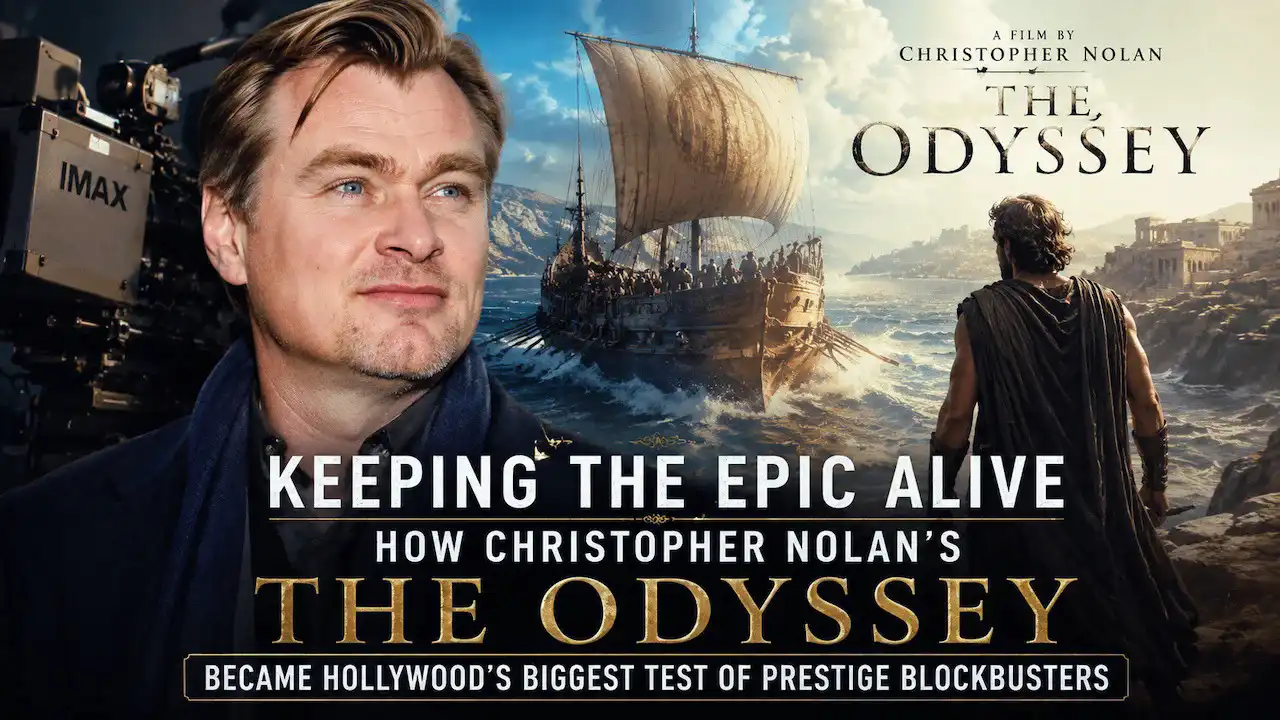
Christopher Nolan The Odyssey Prestige Blockbusters
This article explains why Christopher Nolan’s The Odyssey has become more than another big studio release. It explores how prestige blockbusters create value through director branding, theatrical exclusivity, premium formats, intellectual property, backend deals, and long-term cultural relevance.
Hollywood loves a safe bet, but the safest bets have started to look less certain. Superhero sequels no longer guarantee automatic dominance, streaming has changed audience habits, and studios are once again asking a difficult question. Can a serious, director-led epic still become a global event?
That is why Christopher Nolan’s The Odyssey matters. Universal’s official site lists the film for July 17, 2026, and positions it as shot entirely with IMAX film cameras, turning Homer’s ancient poem into a premium theatrical product before audiences even buy a ticket.
This is not only a movie story. It is an entertainment business story about brand equity, Hollywood money, prestige, ownership deals, streaming rights, residual income, and how major filmmakers build wealth far beyond their salaries.
Why Christopher Nolan’s The Odyssey Matters Now?
Christopher Nolan has become one of the rare modern directors whose name functions almost like a franchise. Most movies are sold through characters, comic book worlds, sequels, or celebrity casts. Nolan sells scale, seriousness, theatrical urgency, and trust.
That trust became even more valuable after Oppenheimer. The film grossed about $975.8 million worldwide, according to Box Office Mojo, making it one of the clearest recent examples of an adult-skewing prestige film becoming a global box office force.
The Odyssey now arrives as the next test. Can a mythological epic based on a public domain literary work compete in a market shaped by superheroes, video game adaptations, horror brands, and streaming attention spans?
For studios, the answer matters because prestige blockbusters are expensive but powerful when they work. They can sell premium tickets, drive international interest, lift a studio’s brand, attract awards attention, and create long-tail value across home entertainment, licensing, and future platform windows.
The Business Model Behind the Money
A film like The Odyssey does not rely on one revenue stream. Its financial story is built across many layers.
Theatrical box office comes first. Premium formats such as IMAX and large-format screens can increase perceived value because audiences feel they are paying for an experience they cannot fully replicate at home. That is central to Nolan’s brand.
After theatrical release, the revenue picture can include digital sales, rentals, physical media, pay television, streaming licensing, airline and hotel licensing, international distribution, soundtrack value, and catalog value. Universal’s own company description notes that its content moves across theatrical, home entertainment, television, and subscription video channels.
This is why a prestige blockbuster can be more than opening weekend. It becomes an asset.
Salary Versus Ownership
Salary is simple. An actor, director, writer, or producer receives an upfront fee for work. It creates immediate income, but it does not always capture the full upside if the project becomes a cultural event.
Ownership and backend participation are different. A filmmaker with gross participation, profit participation, producer credit, or control over certain rights may benefit from long-term performance. Forbes reported that Nolan’s Oppenheimer compensation was estimated at around a first-dollar gross arrangement, meaning his payout was tied to the film’s revenue rather than only a flat directing fee.
That does not confirm the terms of the deal for The Odyssey. Publicly available data does not fully reveal private contracts. Still, Nolan’s career shows why salary alone is too small a lens for measuring Hollywood wealth.
Brand Equity and Audience Trust
Brand equity is the value attached to a name. For Nolan, the brand suggests practical scale, serious storytelling, IMAX spectacle, and a reason to leave the house.
For stars, prestige films can also build brand equity. Matt Damon, Zendaya, Tom Holland, Anne Hathaway, Robert Pattinson, Lupita Nyong’o, and Charlize Theron bring different audience groups and cultural signals. Some offer global box office familiarity. Others bring youth appeal, awards credibility, or social media relevance.
That does not mean followers automatically become ticket buyers. Audience trust is not the same as guaranteed sales. But in a crowded market, recognizable talent helps a studio turn an ancient poem into a modern event.
Helpful Table
| Wealth Driver | How It Works | Why It Matters |
|---|---|---|
| Salary | Upfront payment for acting, directing, writing, or producing | Creates immediate income |
| Backend Deals | Compensation tied to box office or profits | Can create major upside when a film overperforms |
| Royalties | Ongoing payments from reuse, music, books, or related rights | Supports long-term earnings |
| Licensing Deals | Paid use of content, format, music, images, or brand assets | Extends value beyond theaters |
| Residuals | Payments from reuse across TV, streaming, or other platforms | Keeps older work financially relevant |
| Brand Equity | Commercial value of a trusted name or reputation | Helps turn attention into demand |
| Streaming Rights | Paid access for platforms after theatrical windows | Adds another layer to total revenue |
Why Traditional Net Worth Estimates Often Miss the Full Picture?
Celebrity net worth articles often focus on visible income. That includes salary, box office bonuses, endorsement deals, real estate purchases, and public business ventures.
The problem is that the most important wealth drivers are often private. Equity deals, backend terms, tax structures, debt, management fees, production company ownership, trust structures, and deferred compensation may never be fully disclosed.
For a filmmaker like Nolan, public estimates can miss the value of leverage. His wealth story is not only what he earned from one movie. It is also the negotiating power created by decades of box office performance, critical trust, and a loyal audience that associates his name with premium cinema.
The same applies to actors. A star’s net worth is not only the salary from one film. It can include residual income, stakes in production companies, brand partnerships, real estate, investments, licensing deals, and future earning power generated by career positioning.
Examples That Show How This Works
Oppenheimer is the cleanest recent example. It was not based on a superhero, toy, or video game. Yet it became a major worldwide box office success and strengthened Nolan’s value as a director whose name can sell scale on its own.
The Odyssey takes that model into a different lane. Homer’s poem is in the public domain, which means the core source material does not require the same kind of rights ownership as a modern franchise. But the film itself creates new value through its execution, cast, marketing, premium-format positioning, and studio distribution.
That is where prestige blockbusters become interesting. The intellectual property may be ancient, but the commercial package is modern.
The money is not only in the story. It is in the way the story is branded, filmed, released, and owned.
The Risks Behind Prestige Blockbusters
Prestige does not remove risk. Sometimes it increases it.
A large-scale epic needs high awareness, strong reviews, audience urgency, and international appeal. If the film feels too academic, too long, too expensive, or too distant from mainstream taste, the business model can become fragile.
There is also a format risk. IMAX branding helps create urgency, but not every market has enough premium screens. If demand is concentrated in a few major cities, the film still needs a broad turnout in standard theaters.
Star power also has limits. A famous cast can open doors, but it cannot fix a weak product-market fit. Audiences may admire actors without buying tickets. They may praise ambition online and still wait for streaming.
Then there is expectation risk. Nolan’s brand raises the ceiling, but it also raises the pressure. After Oppenheimer, The Odyssey is no longer judged as a normal historical or mythological drama. It is being judged as a major statement about whether director-led cinema can still command blockbuster economics.
What does this reveal about modern celebrity wealth?
Modern celebrity wealth is less about one paycheck and more about leverage.
A salary can make someone rich. Ownership, backend participation, licensing, royalties, and brand equity can make wealth more durable. That is true for actors, musicians, athletes, creators, and filmmakers.
The Odyssey shows how this works at the highest level of Hollywood. Nolan’s value is not only creative. It is financial. His name helps sell tickets, justify premium formats, attract major stars, and give Universal a prestige product that can travel across theatrical and post-theatrical windows.
For the cast, the upside may not only be salary. A major prestige blockbuster can strengthen future negotiating power, build awards-season credibility, expand global visibility, and keep a star connected to culturally important projects.
That is why traditional celebrity net worth estimates can feel incomplete. They often capture income after it becomes visible. They struggle to measure brand trust, negotiating leverage, and the long-term value of being attached to the right project at the right time.
Conclusion
Keeping the epic alive is not just a creative challenge. It is a business challenge.
Christopher Nolan’s The Odyssey is testing whether audiences still want big, serious, theatrical stories when they are packaged with trust, scale, premium technology, and cultural weight. If it works, it could strengthen the case for prestige blockbusters in a Hollywood economy that often leans too heavily on familiar franchises.
The bigger lesson is clear. Modern entertainment wealth is built where art, ownership, distribution, and brand equity meet. The stars and filmmakers who understand that are not just chasing paychecks. They are building long-term value.
FAQs
Why is Christopher Nolan’s The Odyssey important for Hollywood?
It matters because it tests whether a director-led prestige blockbuster can still become a major theatrical event without relying on superhero IP or a modern franchise.
How do prestige blockbusters make money?
They earn through theatrical box office, premium formats, international sales, digital rentals, physical media, streaming rights, licensing, and long-term catalog value.
What is brand equity in Hollywood?
Brand equity is the commercial value attached to a trusted name. For Nolan, it means audiences associate his films with scale, quality, and theatrical urgency.
Why do celebrity net worth estimates miss the full picture?
They often miss private contracts, backend deals, royalties, equity stakes, taxes, debt, management fees, and long-term licensing income.
Can actors earn more from ownership than salary?
Sometimes, yes. Salary provides guaranteed income, but backend participation, production company ownership, royalties, or equity deals can create larger upside if a project succeeds.
Explore more entertainment business breakdowns to understand how Hollywood money, celebrity wealth, ownership deals, and brand equity shape the next generation of stars and filmmakers.

Table of Contents