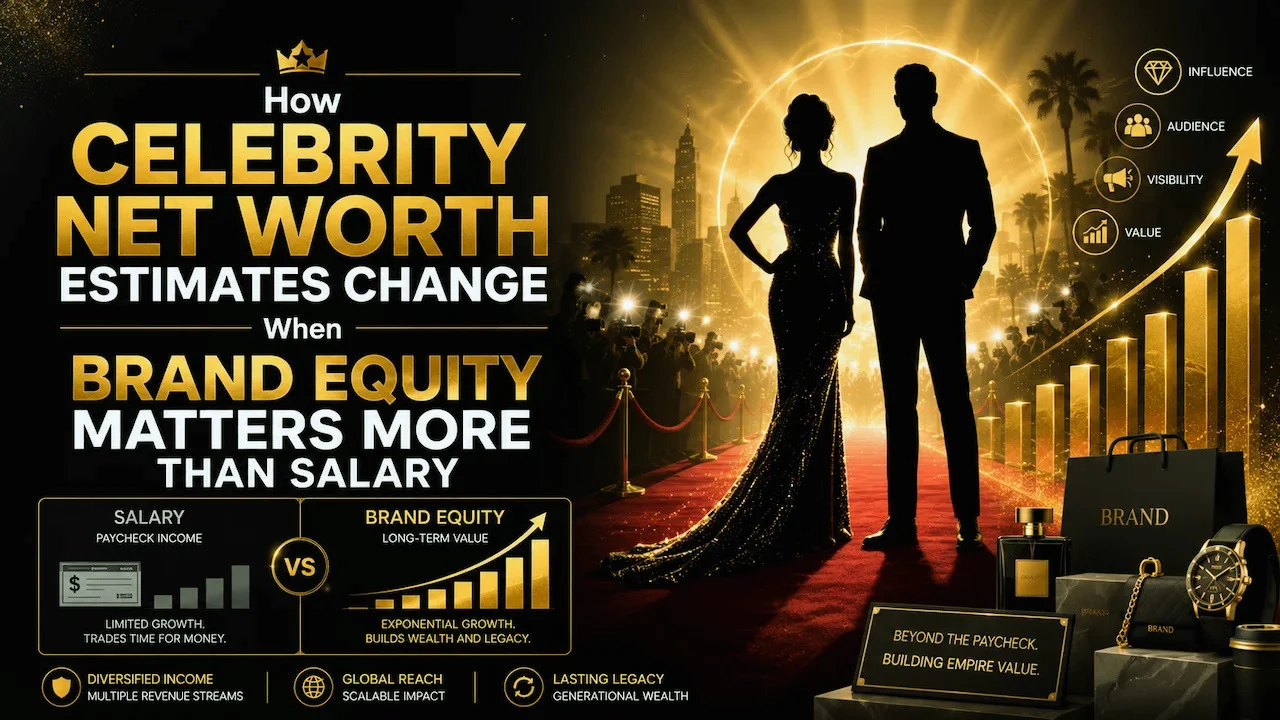
Celebrity Net Worth Estimates When Brand Equity Beats Salary
This article explains why celebrity net worth estimates are harder to measure when fame turns into ownership, licensing power, royalties, and business equity. It shows how modern celebrity wealth is shaped less by salary alone and more by brand value, deal structure, distribution, and long-term assets.
A movie salary is easy to understand. A music catalog, beauty brand stake, tequila exit, licensing deal, or private investment portfolio is much harder to measure.
That is why celebrity net worth estimates can change dramatically when brand equity matters more than salary. The old formula looked at acting fees, album sales, tour income, sports contracts, and endorsement checks. The new formula looks at something deeper: how much financial value a celebrity can create from trust, attention, ownership, and timing.
This matters now because fame has become a business asset. A celebrity is no longer just paid to perform or promote. In many cases, they are building companies, holding equity stakes, licensing their names, controlling intellectual property, and turning audience loyalty into long-term wealth.
Why This Celebrity Wealth Trend Matters Now?
Celebrity wealth used to be easier to explain. Actors earned upfront fees. Athletes signed contracts. Musicians made money from records, touring, publishing, and merchandise. Stars also took endorsement deals when brands wanted to borrow fame.
That model still exists, but it no longer tells the whole story.
Today, the entertainment business rewards celebrities who can move attention across platforms. A star can build trust on-screen, reinforce it on social media, launch a product, license a name, invest in a startup, or use their audience for distribution.
That shift makes brand equity a major part of celebrity net worth. Brand equity is the extra value attached to a name, reputation, image, and audience relationship. It is not just popularity. It is the ability to turn recognition into pricing power, customer loyalty, investor interest, retail placement, media coverage, and repeat sales.
A celebrity with strong brand equity may earn less per year but hold more valuable assets over time. That is why two stars with similar paychecks can have very different financial futures.
The Business Model Behind the Money
Celebrity money now comes from several layers. Some are visible. Others are private, delayed, or difficult to verify.
A salary is straightforward. A studio, label, team, or platform pays the celebrity for work. But ownership deals, royalties, licensing deals, and equity deals can continue to generate value after the original project ends.
That is where celebrity net worth estimates become complicated.
Salary Versus Ownership
Salary is income. Ownership is an asset.
A celebrity who receives a large acting fee gets immediate money, before taxes, agents, managers, lawyers, and other expenses. A celebrity who owns a stake in a company may not receive a large upfront payment, but the stake could become valuable if the company grows or is sold.
This is why equity deals attract stars and investors. A celebrity can provide attention, credibility, and marketing reach. In return, they may receive ownership or upside instead of only a flat endorsement fee.
The risk is clear. Salary is guaranteed once paid. Equity can become highly valuable, or it can become worth very little.
Brand Equity and Audience Trust
Brand equity is not the same as fame. A celebrity can be famous without being trusted. They can also be loved in one category but unconvincing in another.
For example, a beauty brand associated with a celebrity may work when the star’s image fits the product, the quality is strong, and the brand addresses a real consumer need. But a random product with a famous face attached can fade quickly.
Audience trust is the real currency. Fans may try a product because of the celebrity. They only return if the product delivers.
That repeat behavior is what turns celebrity branding into business value.
Helpful Table
| Wealth Driver | How It Works | Why It Matters |
|---|---|---|
| Salary | Upfront payment for acting, music, sports, or appearances | Creates immediate income but may not build long-term assets |
| Royalties | Ongoing payments from music, publishing, books, or product sales | Can create repeat income after the original work |
| Equity | Ownership stake in a company or brand | It can grow significantly if the business succeeds |
| Licensing | Paid use of a celebrity’s name, image, or brand identity | Allows income without the daily operation of the business |
| Residuals | Payments from reruns, reuse, or streaming under contract rules | Helps performers earn from continued distribution |
| Endorsement Deals | Paid partnerships with brands | Converts fame into marketing value |
| Private Investments | Stakes in startups, funds, real estate, or companies | It may change wealth estimates, but it is often hard to verify |
Why Celebrity Net Worth Estimates Often Miss the Full Picture?
Most celebrity net worth estimates rely on public clues. These may include reported salaries, property records, business sales, tour grosses, endorsement reports, lawsuits, public filings, or interviews.
But the richest details are often private.
A celebrity may own a small part of a fast-growing company. They may have royalties from older music, backend points from film projects, licensing income from a product line, or real estate that has appreciated over the years. They may also have debt, taxes, legal costs, management fees, failed investments, or obligations that outsiders cannot see.
That means a public estimate can be directionally useful but rarely perfect.
The biggest mistake is treating a single number as the confirmed truth. Celebrity net worth is usually an estimate, not a bank statement. When brand equity and ownership deals are involved, the gap between visible income and actual wealth can be wide.
Examples That Show How This Works
Rihanna is one of the clearest examples that wealth trackers often discuss. Her music made her globally famous, but public estimates have repeatedly linked a major share of her fortune to Fenty Beauty and related ventures rather than music income alone. The lesson is simple: fame created the audience, but ownership helped create wealth.
George Clooney’s Casamigos story shows another side of the model. The tequila brand, co-founded by Clooney, Rande Gerber, and Mike Meldman, was acquired by Diageo in a deal valued at up to $1 billion. That was not just an endorsement. It was a business exit built around product, branding, distribution, and premium positioning.
Ryan Reynolds offers a modern example from the entertainment business. His role with Mint Mobile was not limited to appearing in ads. The brand used his voice, humor, and marketing style as part of its identity before T-Mobile agreed to acquire Ka’ena Corporation, Mint’s parent company. It showed how celebrity-led creative strategy can become part of enterprise value.
Taylor Swift’s catalog story highlights intellectual property. Her public fight over master recordings and later move to regain control of key rights became a wider lesson in ownership. In music, control over masters, publishing, licensing, and distribution can matter as much as performance income.
None of these examples means every celebrity brand will become huge. They show how wealth changes when the celebrity is more than a talent for hire.
The Risks Behind Celebrity Business Ventures
Celebrity business ventures can fail for boring reasons. That is what makes them important.
A famous founder cannot fix weak margins, poor operations, bad retail strategy, unclear positioning, or a product nobody wants twice. Social media followers may create attention, but attention is not the same as customer retention.
Beauty lines can struggle when the category becomes crowded. Fashion brands can fail when quality, sizing, pricing, or identity miss the mark. Restaurants can collapse under high rent and operating complexity. Alcohol brands can face regulatory pressure, distribution challenges, changing consumer tastes, or brand fatigue.
There is also reputational risk. A celebrity brand is tied to a public image. If that image changes, the business can suffer. Investors know this, which is why serious celebrity ventures usually require experienced operators, clear governance, strong product development, and a business model that can outlast the hype.
What does this reveal about modern celebrity wealth?
Modern celebrity wealth is no longer only about who gets the biggest paycheck. It is about who owns the asset that keeps paying.
A hit film can create a salary. A production company can create leverage. A song can create royalties. A master recording can create control. A beauty brand can create enterprise value. A licensing deal can turn identity into recurring income. A smart equity stake can outperform years of endorsement fees.
This is why celebrity net worth estimates change when brand equity becomes more important than salary. Wealth is moving from one-time compensation toward ownership, intellectual property, and distribution power.
The smartest celebrities are not simply selling attention. They are turning attention into assets.
Conclusion
Celebrity net worth estimates become less reliable when the largest value lies in private deals, equity stakes, royalties, licensing rights, and brand ownership. Salary still matters, but it is only one part of the modern celebrity wealth equation.
The bigger story is the rise of celebrity entrepreneurship. Fame can open doors, but ownership determines whether those doors lead to lasting wealth. As entertainment, commerce, and the creator economy continue to blend, the most valuable stars will be those who understand that their brand is not just publicity. It is business infrastructure.
FAQs
Why do celebrity net worth estimates change?
Celebrity net worth estimates change as new information emerges about salaries, investments, real estate, royalties, business sales, or brand valuations. Many details remain private, so estimates often shift when public data changes.
How do celebrities make money outside of their salary?
Celebrities make money through royalties, licensing deals, endorsement deals, equity stakes, product lines, production companies, real estate, private investments, books, streaming rights, and business partnerships.
What is brand equity in celebrity wealth?
Brand equity is the financial value connected to a celebrity’s name, reputation, audience trust, image, and cultural influence. Strong brand equity can help sell products, attract investors, and increase business value.
Why do some celebrity brands fail?
Celebrity brands fail when the product is weak, the market is crowded, the pricing is wrong, the operations are poor, or the celebrity’s audience does not become loyal customers. Fame can create awareness, but it cannot replace business fundamentals.
Do celebrities make more from ownership than endorsements?
Some celebrities can earn more from ownership than from endorsements, especially if a company grows or is sold. But ownership is riskier because equity can lose value. Endorsements are usually more predictable, while ownership offers greater upside.

Table of Contents