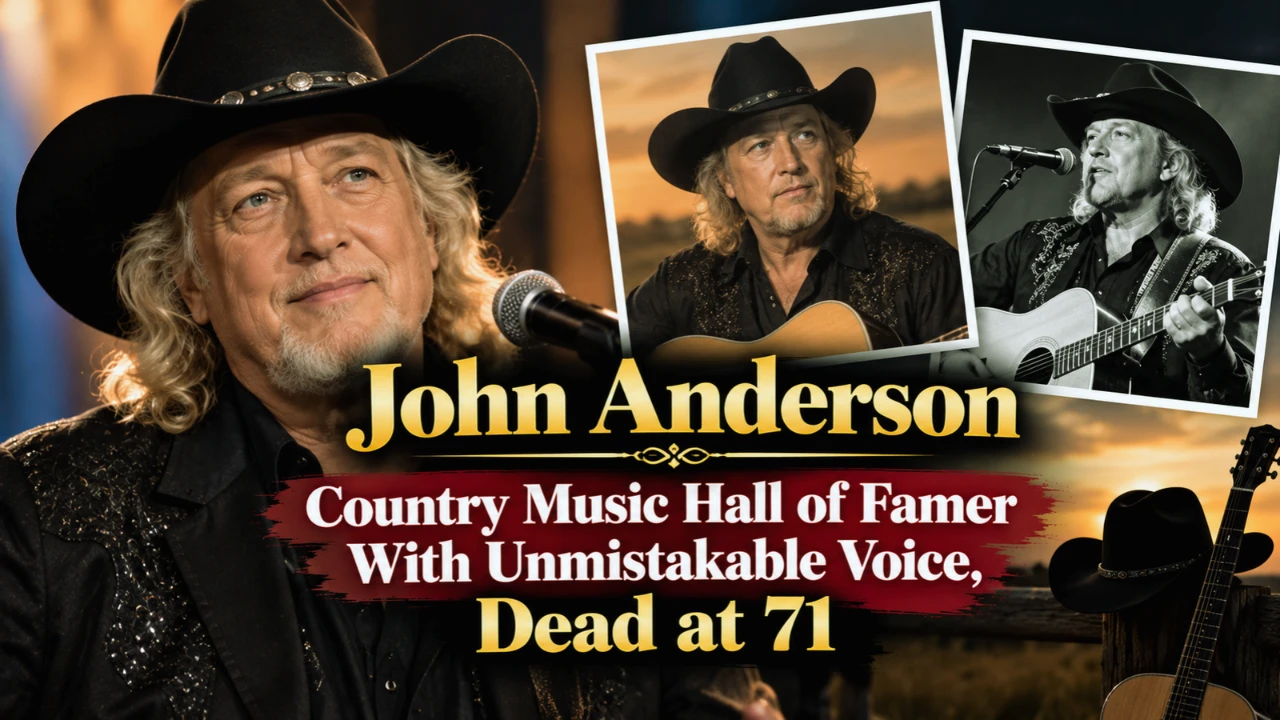
John Anderson, Country Music Hall of Famer With Unmistakable Voice, Dead at 71
John Anderson, the influential country music singer-songwriter who had a deep, resonant baritone and a commitment to traditional sounds that earned him a place in the Country Music Hall of Fame, has died. He was seventy-one years old.
Anderson’s family confirmed the news in a statement released early Thursday. The cause of death has not been immediately released, and the family has asked for privacy during this difficult time. Anderson, a constant in Nashville’s music scene for over four decades, bridged the gap between the outlaw country movement of the 1970s and the neotraditionalist revival of the 1980s and ’90s.
John Anderson, a Country Music Hall of Famer with a distinct voice and hits including “Swingin’” and “Straight Tequila Night,” died at 71. His family confirmed his death on October 22, 2026, after a more than 40-year career in country music.
Key Details
- Who: John Anderson, acclaimed country music vocalist and songwriter.
- What: Passed away at the age of 71.
- When: Confirmed October 22, 2026.
- Where: Nashville, Tennessee area.
- Key Achievement: Inducted into the Country Music Hall of Fame; scored multiple No. 1 hits including “Swingin’.”
- Legacy: Known for preserving traditional country instrumentation and vocal styles amidst changing industry trends.
A Career Defined by Authenticity
Anderson was born in Orlando, Florida, in 1954 and moved to Nashville in the mid-1970s. He was not only a standout singer, but he also quickly established himself as a songwriter with a keen eye for detail and emotion. He first made a name for himself in 1980 with the hit single, “I’ve Got Money,” but it was 1983’s “Swingin'” that launched him to mainstream success. The song reached No. 1 on the Billboard Hot Country Singles chart and became a lasting anthem of the genre.
Anderson stuck with traditional country arrangements, while many of his contemporaries went for pop-crossover production. His rich baritone voice, with a slight twang, was often likened to Lefty Frizzell and Merle Haggard. This dedication to authenticity won him deep respect among his peers and critics alike, even as radio formats began to embrace more polished, pop-oriented sounds.
Anderson enjoyed a string of hits in the 1980s and 1990s, including “Wild and Blue,” “Straight Tequila Night,” “Money in the Bank,” and “Would You Catch Another Falling Star.” In his prime, he was named ACM and CMA Male Vocalist of the Year.
Hall of Fame Recognition
Anderson was inducted into the Country Music Hall of Fame in 2010, formally recognizing his lasting influence on the genre. In his acceptance speech, Anderson stressed the importance of songwriting and country music roots.
“It’s an honor to be mentioned in the same breath as the people who built this house,” Anderson said at the time. “Country music is about truth, and if you’re singing the truth, people will listen.
His impact went beyond his own recordings. Artists such as Alan Jackson, George Strait, and newer generations like Luke Combs and Chris Stapleton have cited Anderson as a key force in keeping country music’s sonic traditions intact.
What Officials and Peers Said
The announcement was followed shortly by tributes from across the music industry.
“John was one of the truest voices we ever had,” said fellow Hall of Famer and longtime friend Vince Gill. He was not fashionable. He just sang songs that meant something, the way only he could. “Nashville has lost a giant.”
The Country Music Hall of Fame and Museum released a statement acknowledging his legacy: “John Anderson’s contribution to country music is immeasurable. His voice was the voice of a generation, and his commitment to the craft inspired countless artists. “Our most heartfelt sympathies to his family and fans.
Garth Brooks also shared a memory on social media, remembering Anderson’s mentorship early in his career. “He taught me that the song is always bigger than the singer,” Brooks wrote. “Be at rest, John.”
Why It Matters
John Anderson’s passing means losing one of the last direct links to the “outlaw” and traditionalist movements that helped shape modern country music. In an era when the genre still debates its identity and direction, Anderson was a pillar of its foundational sound. His knack for achieving commercial success without compromising artistic integrity provided a model for subsequent artists who aimed to balance mainstream appeal with their traditional roots.
His death also reminds us of the lasting power of vocal idiosyncrasy in an increasingly produced musical environment. Anderson proved a single voice and well-wrought songs could talk across generations.
What Happens Next
Funeral arrangements and public memorial services have not yet been publicly announced. The family said a private service is planned for now, with a public celebration of life to be held in Nashville. Fans are expected to gather at iconic Nashville venues linked to Anderson’s career, including the Ryman Auditorium and the Bluebird Cafe, to pay their respects.
In the next few days, the Country Music Hall of Fame expects to release a formal tribute schedule.
FAQ
What was John Anderson’s most famous song?
Arguably, John Anderson’s biggest hit is “Swingin’,” which went No. 1 on the Billboard country charts in 1983 and still receives frequent classic-country radio play.
When was John Anderson inducted into the Hall of Fame?
In 2010, Anderson was inducted into the Country Music Hall of Fame for his contributions to the genre for three decades.
Did John Anderson write his own songs?
Yes, John Anderson was a very prolific songwriter. He wrote the hit “Wild and Blue” and “Straight Tequila Nite,” and he also wrote or co-wrote for other artists, including Bill Monroe and Conway Twitty.
What style of country music did John Anderson sing?
John Anderson was a classic country singer whose style incorporated elements of honky-tonk and the outlaw country movement. He was a major player in the neotraditionalist wave of the 1980s.

Table of Contents