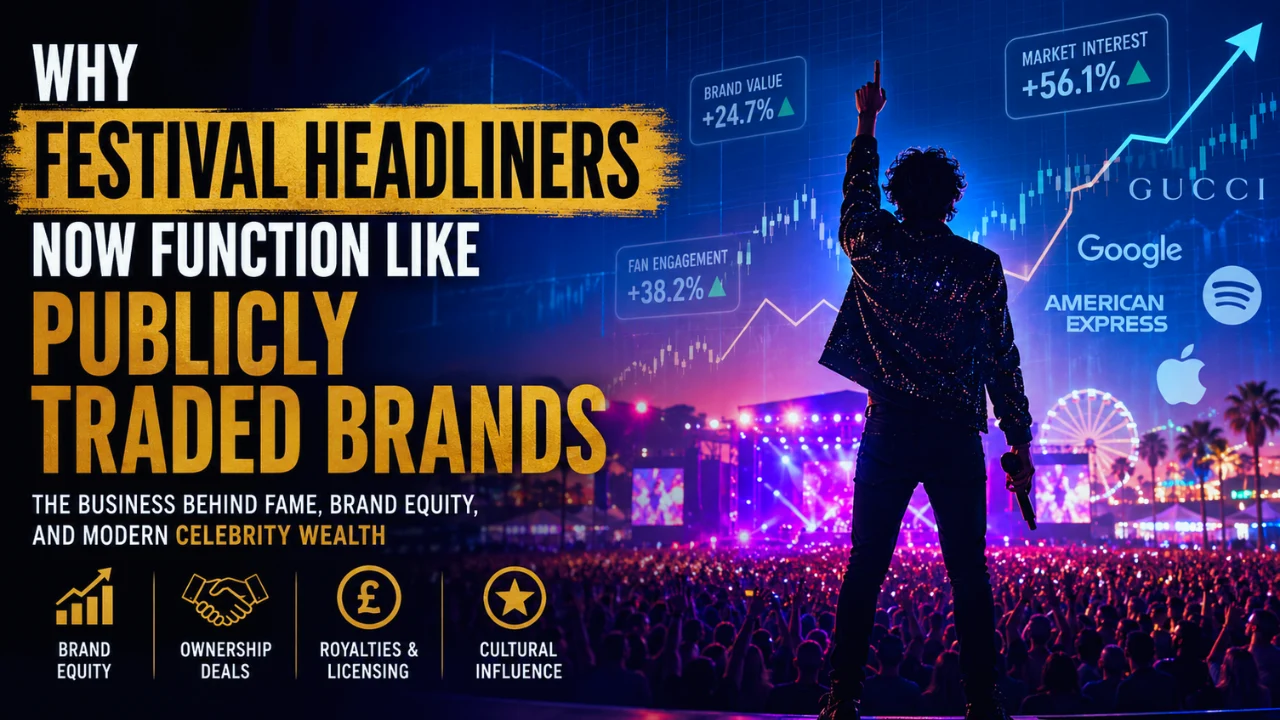
Festival Headliners as Publicly Traded Brands
When a festival announces its headliners, the reaction often looks surprisingly familiar. Fans speculate about value. Media outlets debate whether the lineup is “worth it.” Sponsors evaluate audience reach. Ticket sales rise or fall based on a handful of names.
That is why festival headliners now function like publicly traded brands.
The biggest names in live entertainment are no longer valued solely on album sales or touring revenue. Their economic power increasingly resembles a company stock. Their “market cap” is measured through cultural relevance, audience trust, merchandising potential, streaming performance, endorsement deals, and their ability to move millions of pounds in consumer spending with a single announcement.
In today’s entertainment business, a headliner is not simply an artist. They are an ecosystem.
Why This Celebrity Wealth Trend Matters Now?
Live entertainment has become one of the strongest sectors in modern media. While streaming changed how audiences consume music, festivals became premium experiences that fans are willing to pay for.
Events like Coachella, Glastonbury, and Lollapalooza are no longer selling tickets alone. They are selling access to brands represented by their headliners. Industry observers often note that a major headliner can influence sponsorship interest, media coverage, livestream engagement, and merchandise sales across an entire festival season.
Consider what happens when artists like Beyoncé, Taylor Swift, Bad Bunny, or Blackpink enter a headline slot. The conversation extends far beyond music. Fashion brands launch collaborations. Streaming numbers often receive a boost. Social media engagement surges. Documentary opportunities emerge.
Their names function much like publicly traded companies during earnings season. Every appearance becomes a signal of momentum.
This shift also reflects broader changes in the creator economy. Modern celebrity wealth increasingly comes from ownership, licensing deals, private investments, and intellectual property rather than a single paycheck.
The Business Model Behind the Money
Festival headliners generate value across multiple revenue streams simultaneously.
A performance fee may be the most visible component, but it is rarely the entire story. Major appearances can create downstream benefits that continue long after the stage lights go dark.
| Wealth Driver | How It Works | Why It Matters |
|---|---|---|
| Performance Fees | Payment for festival appearances | Creates immediate income |
| Royalties | Earnings from music consumption | Generates recurring revenue |
| Licensing Deals | Use of name, image, and likeness | Expands income opportunities |
| Brand Partnerships | Sponsored campaigns and endorsements | Converts fame into commercial value |
| Merchandising | Product sales tied to the artist | Builds direct-to-consumer revenue |
| Equity Investments | Ownership in businesses | Can appreciate over time |
| Streaming Rights | Revenue from documentaries and concerts | Extends the life of performances |
Salary Versus Ownership
A headline performance is often viewed as a payday, but ownership is where long-term wealth is built.
Beyoncé’s Coachella appearance eventually became Homecoming, a cultural event that expanded into streaming value and strengthened her broader business empire. Similarly, many artists use festival appearances to support tours, launch products, or reinforce their position in the market.
An artist who owns masters, merchandise rights, or stakes in consumer businesses can generate value long after the initial appearance fee has been spent.
That distinction matters.
Salary pays today’s bills. Ownership can create wealth that lasts decades.
Brand Equity and Audience Trust
Brand equity is one of the least understood aspects of celebrity wealth.
Publicly traded companies derive value from future expectations. Festival headliners operate in much the same way.
Promoters are not simply paying for a 90-minute set. They are paying for audience confidence. They are buying the likelihood that fans will purchase tickets, engage online, and participate in the surrounding cultural moment.
That explains why some artists command significantly larger fees than others despite similar streaming numbers.
Audience trust is an asset.
Brand equity also influences:
- Sponsorship negotiations
- Licensing deals
- Documentary opportunities
- Merchandise performance
- International expansion
- Future tour demand
- Investor confidence in celebrity-owned businesses
Why Traditional Net Worth Estimates Often Miss the Full Picture?
Celebrity net worth estimates remain popular, but they rarely tell the complete story.
Public websites generally rely on available records, reported salaries, and public transactions. They often cannot account for:
- Private investments
- Undisclosed equity deals
- Licensing agreements
- Future royalty streams
- Debt obligations
- Management and production costs
- Tax liabilities
- Intellectual property valuations
A festival headliner may appear to have earned a substantial fee, yet much of their wealth could be tied to businesses the public knows little about.
The opposite can also be true.
An artist with modest reported earnings might quietly own valuable assets across music publishing, consumer products, or venture investments.
Modern celebrity wealth is increasingly difficult to calculate because entertainers are behaving more like diversified holding companies than individual performers.
That Shows How This Works
Several public examples demonstrate this trend.
Beyoncé transformed a festival appearance into an enduring media property through Homecoming.
Blackpink’s rise to headliner status highlighted how global fandom, luxury partnerships, and international reach can elevate an artist’s commercial value beyond music alone.
Bad Bunny’s headline appearances reinforced his position as a global cultural force across music, fashion, and brand collaborations.
More recently, festival ecosystems have become heavily intertwined with celebrity brands. Coachella’s surrounding activations increasingly include beauty companies, tequila brands, fashion labels, and influencer-led experiences connected to major talent.
In many cases, the headliner becomes the center of an entire commercial ecosystem.
That ecosystem can generate value for sponsors, media companies, streaming platforms, and investors alike.
The Risks Behind Celebrity Business Ventures
Not every headline slot translates into lasting wealth.
Celebrity brands can fail for the same reasons traditional businesses do:
- Poor management
- Overexpansion
- Weak product-market fit
- Audience fatigue
- Reputation damage
- Licensing disputes
- Shifting consumer trends
- Inconsistent creative output
Festival culture itself can be volatile.
A poorly received performance can affect public perception. An extended absence from touring can reduce momentum. Changes in audience tastes can alter an artist’s market position faster than many expect.
Frank Ocean’s widely discussed Coachella appearance in 2023 became a reminder that cultural capital can fluctuate quickly.
Publicly traded companies experience volatility. Celebrity brands do too.
The difference is that celebrity “share prices” are measured through attention, relevance, and consumer trust rather than stock exchanges.
What This Reveals About Modern Celebrity Wealth?
The entertainment industry has entered an ownership era.
For decades, celebrity wealth was closely tied to record sales, film salaries, or television contracts. Today, wealth is increasingly built through intellectual property, equity deals, licensing, and strategic partnerships.
Festival headliners sit at the center of this transformation.
Their value extends across multiple industries:
- Music
- Film and streaming
- Fashion
- Consumer products
- Hospitality
- Technology
- Advertising
- Live entertainment
That is why a festival lineup announcement can feel like a financial event.
The market is reacting to brands.
And as celebrity entrepreneurship continues to expand, the gap between entertainers and corporations will likely become even smaller.
The next generation of headliners may be judged less by how many songs they release and more by how effectively they build, protect, and monetize their brands.
Conclusion
Festival headliners have evolved far beyond performers collecting appearance fees. They are cultural businesses with portfolios of assets, partnerships, and intellectual property.
Understanding how these brands operate offers a clearer picture of modern celebrity wealth. It also explains why traditional net worth estimates often fail to capture the full economic reality behind fame.
As entertainment, technology, and commerce continue to merge, festival stages may increasingly serve as public marketplaces where audiences, sponsors, and investors collectively decide which celebrity brands are rising and which are losing momentum.
FAQs
Why do festival headliners command such high fees?
Major headliners can influence ticket sales, sponsorship interest, media coverage, and streaming engagement, making them valuable business assets.
How do celebrities make money outside festival appearances?
Many celebrities earn income through royalties, licensing deals, endorsements, merchandise, equity investments, and business ventures.
What is brand equity in celebrity wealth?
Brand equity refers to the commercial value associated with a celebrity’s reputation, audience trust, and cultural relevance.
Why are celebrity net worth estimates often inaccurate?
They typically rely on public information and may not include private investments, ownership stakes, taxes, debts, or undisclosed deals.
Do celebrities make more from ownership than endorsements?
It depends on the individual, but ownership can create long-term wealth if a business grows successfully over time.
Interested in the business behind fame? Explore more celebrity wealth analysis, entertainment business breakdowns, and modern net worth stories to see how today’s biggest stars build fortunes beyond the spotlight.
Table of Contents