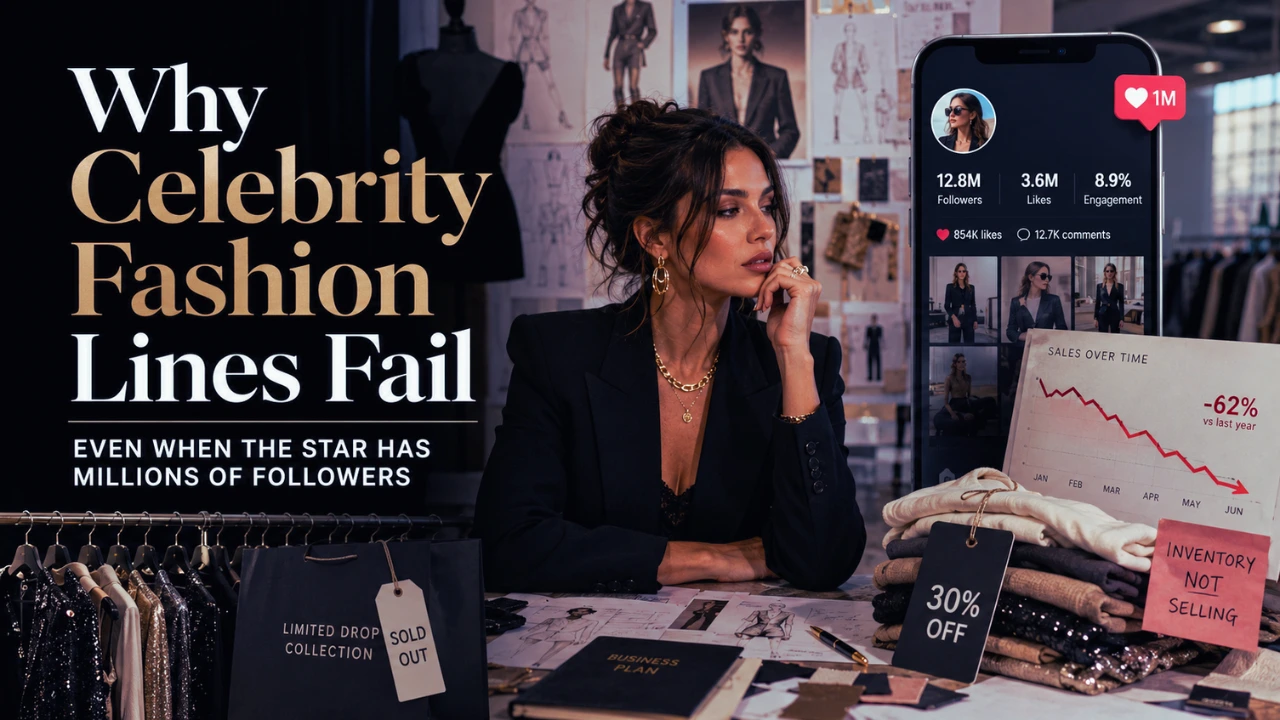
Why Celebrity Fashion Lines Fail Despite Massive Followings
This article explains why celebrity fashion lines fail even when the star has millions of followers and global visibility. It breaks down the money behind celebrity brands, including ownership deals, licensing, royalties, product margins, and why celebrity net worth estimates often miss the deeper business picture.
A famous name can sell out a launch. It cannot save a weak fashion business forever.
That is the quiet lesson behind many celebrity fashion lines. A star may have millions of followers, constant media attention, and a powerful personal brand. Yet, the clothing label still disappears, gets sold, loses retail support, or quietly stops releasing new collections.
That is why celebrity fashion lines fail more often than fans expect. Followers create attention, but fashion needs repeat customers, strong product design, inventory control, pricing discipline, retail strategy, and trust. Fame opens the door. The business has to keep people coming back.
This matters because modern celebrity wealth is no longer built only from movie salaries, music royalties, sports contracts, streaming rights, or endorsement deals. Hollywood money increasingly comes from ownership, licensing, equity, private investments, and business ventures. But fashion is one of the hardest categories to turn into lasting wealth.
Why This Celebrity Wealth Trend Matters Now?
Celebrity entrepreneurship has become a major part of the entertainment business. Actors, musicians, athletes, influencers, and reality TV stars now use fame as a launchpad for beauty brands, tequila companies, restaurants, production houses, podcasts, and fashion lines.
The appeal is obvious. A celebrity with a loyal audience can reduce customer acquisition costs. Instead of paying millions to launch a new label, the star can promote directly through Instagram, TikTok, interviews, red-carpet appearances, and fan communities.
But social media reach can be misleading. A follower is not the same as a buyer. A like is not the same as loyalty. A viral post does not guarantee healthy margins.
Fashion is especially unforgiving because it combines creativity with operational pressure. The brand has to predict trends, source materials, manage sizing, handle returns, negotiate retail placement, price correctly, and avoid appearing low-effort.
That is why a celebrity fashion line can generate huge buzz at launch and still struggle after the first drop. The audience may admire the star, but shoppers ask a different question: Would I wear this if the celebrity’s name were removed?
Why Celebrity Fashion Lines Fail Even With Millions of Followers?
The biggest mistake is assuming that fame automatically translates into demand.
Celebrity fans may love a performer’s music, films, style, or public image, but fashion purchases are personal. People buy clothes based on fit, price, quality, identity, comfort, trend relevance, and lifestyle. A celebrity name may attract curiosity, but the product has to make sense in a real wardrobe.
Many celebrity brands fail because they confuse attention with brand equity. True brand equity means customers trust the label beyond the founder. It means the clothes feel consistent, recognizable, and worth the price.
A weak celebrity fashion line often has one or more of these problems:
| Failure Point | What Happens | Why It Hurts the Business |
|---|---|---|
| Weak product fit | Clothes do not match customer needs | Fans look once but do not return |
| Bad pricing | Items feel too expensive or too cheap for the brand image | Customers question value |
| Overreliance on fame | Marketing focuses on the celebrity more than the product | The brand fades when hype fades |
| Poor distribution | Products are hard to find or placed in the wrong stores | Sales never scale properly |
| Trend mismatch | Collections arrive late or feel disconnected from the culture | Inventory can pile up |
| Low trust | Customers doubt the quality or authenticity | Repeat purchases fall |
Fashion also has a timing problem. A celebrity can be culturally hot when a deal is signed, but product development can take months. By the time a collection launches, public attention may have shifted.
The Business Model Behind the Money
Celebrity fashion lines usually make money through several possible structures. The star may own the company, license their name, take royalties, receive an upfront endorsement fee, hold equity, or partner with a manufacturer or retailer.
The structure matters because it decides who carries the risk.
A pure endorsement deal can pay well upfront, but it may not create long-term wealth. A licensing deal can produce royalties with less operational involvement, but the celebrity may have limited control. An equity deal can create major upside if the company grows, but it can also become worthless if the business fails.
Salary Versus Ownership
Salary is immediate income. Ownership is potential long-term value.
A celebrity paid to promote a clothing line earns money whether the collection becomes a lasting brand or not. But a celebrity who owns a stake in the business may benefit from future profits, acquisitions, funding rounds, or a brand sale.
That is why ownership deals are so attractive in the creator economy. The upside can be much larger than a campaign fee. But ownership also exposes the star to business risk, reputation risk, and the possibility that the public confuses business failure with personal failure.
Brand Equity and Audience Trust
A celebrity’s name, image, and fan base can become financial assets. That is brand equity.
But fashion shoppers can be skeptical. They can tell when a star is deeply involved and when a product feels like a quick licensing play. Celebrity brands work best when the product reflects something believable about the person.
Rihanna’s beauty success, Kim Kardashian’s shapewear success, and Jessica Simpson’s accessible fashion positioning all show a similar lesson: the celebrity identity has to match the consumer promise. The product cannot feel random.
Why Traditional Net Worth Estimates Often Miss the Full Picture?
Celebrity net worth estimates often look cleaner than reality.
Public sites may track salaries, visible endorsement deals, real estate, reported brand sales, and public company stakes. But they often miss private investments, undisclosed ownership deals, taxes, debt, management fees, divorce settlements, licensing terms, royalties, and business liabilities.
A celebrity fashion line also complicates the picture. Retail sales are not the same as personal income. A brand may generate large sales, but that does not mean the celebrity personally keeps that amount. Revenue has to cover manufacturing, shipping, retailer margins, marketing, staff, returns, legal costs, warehousing, and debt.
That is why celebrity wealth should be discussed carefully. A star may be associated with a billion-dollar brand, but their actual income depends on ownership percentage, contract terms, distributions, taxes, and liquidity. Publicly available data can suggest scale, but it rarely confirms the full financial picture.
Examples That Show How This Works
Rihanna’s Fenty fashion house is a useful case because it shows that even a powerful celebrity and a luxury giant cannot guarantee success in ready-to-wear. Reuters reported that LVMH and Rihanna agreed to suspend the Fenty fashion line less than two years after launch, while continuing to focus on beauty, skincare, and lingerie.
Beyoncé’s Ivy Park also shows the limits of fame in fashion. Reuters reported that Adidas ended its fashion partnership with Beyoncé, citing reports that Ivy Park sales had underperformed expectations and that the parties had major creative differences.
The Yeezy and Adidas split shows another kind of risk. Yeezy was not a simple failure of demand. It was a major commercial partnership that became deeply exposed to reputational and dependency risk. Reuters later reported that Adidas sold its remaining Yeezy inventory and detailed how much revenue the sell-off generated in 2023 and 2024.
On the success side, Skims shows what happens when celebrity reach is combined with product focus, operational leadership, funding, and category expansion. Reuters reported that Skims raised $225 million at a $5 billion valuation in 2025, with plans to expand product lines, retail stores, and international presence.
Jessica Simpson’s fashion business offers another important lesson. Her brand has long been cited as a rare celebrity fashion success because it spoke to a broad customer rather than selling only an aspirational celebrity fantasy. Walmart announced a 2024 collaboration with The Jessica Simpson Collection featuring 100 items across women’s apparel, plus fashion, swim, and jewelry, with availability online and in more than 800 stores.
These examples prove the same point from different angles. Followers help. They do not replace product strategy.
The Risks Behind Celebrity Business Ventures
Celebrity fashion lines fail for many of the same reasons other fashion businesses fail, but the public spotlight makes every weakness louder.
The first risk is product-market fit. A celebrity may love a design direction that does not match what fans actually want to buy. A star known for luxury style may struggle if fans cannot afford luxury pricing. A celebrity known for red carpet fashion may not automatically understand everyday fit, comfort, or sizing.
The second risk is overexpansion. Once a celebrity brand gets attention, investors and partners may push it into too many categories too quickly. Apparel, footwear, accessories, swimwear, beauty, fragrance, and home goods all require different supply chains and customer expectations.
The third risk is weak operating control. Some celebrity brands are mostly licensing deals. That can create income through royalties, but it also means manufacturers and partners may influence quality, pricing, design, and retail placement. If the product disappoints customers, the celebrity still takes the reputational hit.
The fourth risk is audience fatigue. Celebrity brands now surround fans. Beauty, alcohol, fashion, wellness, supplements, and lifestyle products compete for the same wallet. The novelty of a famous founder is weaker than it once was.
The fifth risk is reputation. A controversy, public backlash, legal dispute, or shift in cultural taste can hurt a brand more quickly than a typical retailer because the founder is the marketing engine.
What does this reveal about modern celebrity wealth?
The bigger lesson is simple: celebrity wealth is now built at the intersection of fame, ownership, distribution, timing, and trust.
A star can still earn from salaries, royalties, residual income, touring, box office bonuses, streaming rights, and endorsement deals. But the largest wealth-building opportunities often come from owning assets that can scale.
That is why equity deals and private investments matter so much. A celebrity who owns a stake in a successful brand may benefit from future growth in ways that a one-time endorsement cannot match.
Still, fashion is not easy wealth. It is capital-intensive, trend-sensitive, and operationally complex. A celebrity fashion line needs more than a famous founder. It needs a reason to exist.
The brands that last usually do three things well: they solve a real customer problem, they build trust beyond the celebrity, and they create a business model strong enough to survive after the launch hype fades.
Conclusion
Celebrity fashion lines fail because fame is not the same as product demand. Millions of followers can create noise, but customers decide with their wallets, their wardrobes, and their trust.
The most successful celebrity brands are not just fan merchandise. They are real businesses with clear positioning, quality control, smart distribution, disciplined pricing, and credible ownership structures.
For readers tracking celebrity net worth and Hollywood money, this is the key takeaway: the future of celebrity wealth is not only about who is famous. It is about who can turn attention into durable assets.
FAQs
Why do celebrity fashion lines fail?
Celebrity fashion lines fail when fame does not translate into repeat purchases. Common reasons include weak product quality, poor pricing, bad timing, unclear brand identity, limited distribution, and overreliance on social media hype.
Do millions of followers guarantee fashion sales?
No. Followers can create awareness, but they do not guarantee sales. Fashion shoppers care about fit, style, price, quality, and trust. A fan may support a celebrity online without buying their clothes.
How do celebrities make money from fashion lines?
Celebrities can make money through ownership, royalties, licensing deals, endorsement fees, profit participation, or equity deals. The exact structure depends on the contract and is often not fully public.
Why do celebrity net worth estimates miss fashion income?
Net worth estimates may miss private investments, undisclosed equity, licensing terms, debt, taxes, management fees, and real ownership percentages. Retail sales do not equal personal income.
Are celebrity-owned fashion brands a good business?
They can be, but only when the product, pricing, distribution, and brand trust are strong. Celebrity attention helps with launch visibility, but long-term success depends on business execution.
For more breakdowns of celebrity wealth, business ventures, ownership deals, and entertainment money, explore our latest celebrity net worth and Hollywood business analysis articles.
Table of Contents