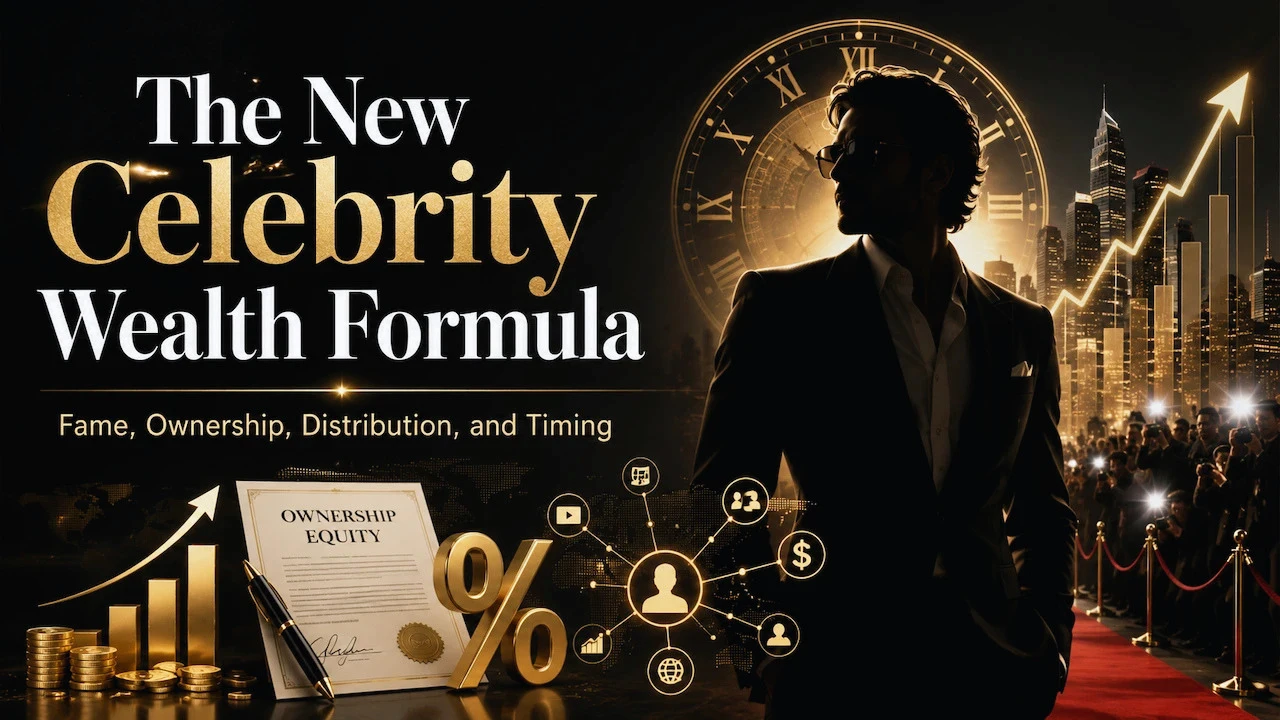
Celebrity Wealth Formula Behind Ownership and Brand Equity
This article explains how modern celebrity wealth is built through more than salary, fame, or headline net worth estimates. It breaks down the new celebrity wealth formula through ownership, distribution, timing, brand equity, royalties, licensing deals, and business ventures.
A celebrity used to become rich by getting paid well. A movie star landed a huge salary. A singer sold albums. An athlete signed a bigger contract. That still matters, but it is no longer the full story.
The new celebrity wealth formula is built on four connected forces: fame, ownership, distribution, and timing. Fame creates attention. Ownership turns that attention into an asset. Distribution decides how far the product travels. Timing determines whether the market is ready.
That is why celebrity net worth estimates can feel incomplete. They often catch the visible money, such as salaries, endorsements, and public deals. They can miss the deeper financial picture, including equity deals, private investments, royalties, licensing, streaming rights, residual income, and brand value.
Why This Celebrity Wealth Trend Matters Now?
Celebrity wealth has changed because the entertainment business has changed.
Stars no longer need to wait for studios, labels, or networks to control every path to consumers. A performer with a loyal audience can sell beauty products, alcohol, clothing, wellness brands, podcasts, production deals, newsletters, live events, or digital memberships.
That does not mean every celebrity brand becomes valuable. Followers are not the same as customers. Hype is not the same as repeat sales. But when fame is matched with a real product, strong operations, and smart distribution, celebrity entrepreneurship can become a serious wealth-building machine.
This is why Hollywood money now looks more like startup money. The biggest upside often comes when a celebrity owns a stake in the business rather than just taking a check to promote it.
The Business Model Behind the Money
Celebrity wealth usually comes from several income streams working together. The most obvious one is salary. Actors get paid for films. Musicians get paid for performances. Athletes get paid through contracts. Influencers get paid for campaigns.
But long-term wealth often comes from assets.
An asset can continue to generate value after the original work is done. That may be a catalog, a trademark, a stake in a consumer brand, a production company, publishing rights, real estate, or a licensing agreement.
Residuals also matter. SAG-AFTRA describes residuals as compensation for use of a TV, theatrical, or new media project beyond what was covered by the performer’s initial pay. That is why reruns, reuse, and streaming windows still matter in entertainment money.
Salary Versus Ownership
Salary is immediate income. Ownership is potential upside.
A star might earn millions for appearing in a movie, hosting a show, or endorsing a product. That money is valuable, but the contract usually caps it.
Ownership works differently. If a celebrity owns equity in a brand, production company, or intellectual property, the value of that equity can rise as the business grows. It can also fall if the business struggles.
That is the key difference. Salary pays for labor and visibility. Ownership pays for value creation.
Brand Equity and Audience Trust
Brand equity is the value attached to a name, image, reputation, and emotional connection with an audience.
For celebrities, brand equity can be powerful because fans already have a relationship with them. They know their style, voice, values, taste, and public story. That trust can reduce the cost of attention.
But brand equity is fragile. A famous name can get people to look once. It cannot force them to buy twice. Repeat sales depend on product quality, price, distribution, service, timing, and whether the brand feels authentic.
Helpful Wealth Driver Table
| Wealth Driver | How It Works | Why It Matters |
|---|---|---|
| Salary | Upfront payment for acting, music, sports, hosting, or appearances | Creates immediate income but is usually capped |
| Royalties | Ongoing payments from music, publishing, books, or creative use | Can support long-term income after release |
| Equity | Ownership stake in a company or venture | Can grow if the business increases in value |
| Licensing | Paid use of name, image, likeness, trademark, or brand | Allows income without running the full operation |
| Residuals | Payments from reuse, reruns, streaming, or re-airings | Keeps older work financially relevant |
| Endorsement Deals | Paid campaigns with brands | Converts public attention into marketing income |
| Distribution Rights | Control over where and how content or products reach consumers | Can shape scale, margins, and leverage |
Why Traditional Net Worth Estimates Often Miss the Full Picture?
Celebrity net worth is hard to verify because much of celebrity wealth is private.
A public salary is easier to report than a private investment. A movie fee may be leaked. A brand sale may be announced. But equity percentages, taxes, debt, management fees, legal costs, ownership dilution, private holdings, and future earn-outs are rarely fully visible.
Net worth sites also face another challenge: valuation is not cash.
A celebrity may hold a stake in a company valued at billions, but that does not mean the celebrity has received that amount in cash. The value may depend on future funding rounds, sales performance, investor demand, or an eventual acquisition.
That is why careful wording matters. A celebrity may be “estimated” to be worth a certain amount, but unless full financial records are public, their exact wealth cannot be confirmed.
Examples That Show How This Works
The spirits business gives clear examples of the new celebrity wealth formula.
Diageo’s 2017 agreement to acquire Casamigos valued the tequila brand at up to $1 billion, including $700 million upfront and a possible $300 million performance-linked earn-out over 10 years. The brand was created by George Clooney, Rande Gerber, and Mike Meldman, and Diageo said the founders would stay involved.
Ryan Reynolds and Aviation Gin show a similar pattern. Diageo announced in 2020 that it would acquire Aviation Gin and Davos Brands in a deal worth up to $610 million, including upfront and performance-based consideration. The company also said Reynolds would retain an ongoing ownership interest in Aviation American Gin.
Beauty and apparel tell the same story from a different angle. LVMH says Fenty Beauty by Rihanna launched with a focus on inclusion, hard-to-match skin tones, and 40 foundation shades. That positioning helped turn celebrity identity into a product promise, not just a famous face on packaging.
Kim Kardashian’s Skims is another example of celebrity brand equity meeting product-market fit and distribution. The company raised $270 million in 2023 at a reported $4 billion valuation, according to Retail Dive, and Reuters later reported a 2025 funding round that valued Skims at $5 billion.
The Risks Behind Celebrity Business Ventures
The celebrity wealth formula can create huge upside, but it also creates real risk.
A celebrity brand can fail if the product is weak, the price is wrong, or the business expands too quickly. Restaurants can struggle with leases, staffing, food costs, and inconsistent customer experience. Fashion lines can face inventory problems, sizing complaints, trend shifts, and heavy competition. Alcohol brands can be expensive to distribute. Beauty brands need product trust, shade range, supply chain control, and repeat purchases.
Timing can also hurt. A concept that feels fresh in one year can feel crowded the next.
Rihanna’s Fenty story shows both sides. Fenty Beauty became a major example of celebrity-led beauty positioning. Still, Reuters reported that LVMH and Rihanna agreed in 2021 to suspend the Fenty fashion line less than two years after launch while focusing on lingerie and cosmetics.
That does not make the broader Fenty ecosystem a failure. It shows the smarter lesson: even powerful celebrities and luxury partners have to adjust when a category, timing, or operating model does not work as planned.
What does this reveal about modern celebrity wealth?
Modern celebrity wealth is no longer only about who earns the biggest paycheck.
The larger question is who owns the asset, who controls distribution, who benefits from repeat sales, and who enters the market at the right moment.
A celebrity with a one-time endorsement gets paid once. A celebrity with equity may benefit if the company grows. A performer with residuals may continue to earn from past work. A musician with publishing or catalog rights may hold an asset that can grow in value. A creator with direct access to their audience may build a business without asking traditional media gatekeepers for permission.
This is the real shift. Fame is still the starting point, but ownership is what turns attention into wealth.
Conclusion
The new celebrity wealth formula is simple to understand but difficult to execute. Fame creates the opening. Ownership creates upside. Distribution creates scale. Timing decides whether the market responds.
That is why celebrity net worth estimates often miss the bigger financial picture. The visible paycheck is only one part of the story. The deeper wealth may sit inside equity deals, royalties, licensing deals, residual income, private investments, intellectual property, and brand equity.
The next generation of celebrity wealth will belong less to stars who are paid only for attention and more to those who turn attention into durable assets.
FAQs
Why do celebrity net worth estimates change?
Celebrity net worth estimates change because salaries, business valuations, investments, real estate, royalties, debt, taxes, and private equity stakes can shift over time. Many details are not publicly confirmed.
How do celebrities make money outside of their salary?
Celebrities make money through endorsements, royalties, licensing deals, equity deals, production companies, brand ownership, private investments, real estate, streaming rights, and residual income.
What is brand equity in celebrity wealth?
Brand equity is the financial value of a celebrity’s reputation, audience trust, style, credibility, and cultural influence. It can help sell products, attract partners, and support business ventures.
Why do some celebrity brands fail?
Celebrity brands can fail because fame does not guarantee product-market fit. Weak products, bad timing, poor management, overpricing, overexpansion, and audience fatigue can damage sales.
Do celebrities make more from ownership than endorsements?
Sometimes they do, but not always. Endorsements offer guaranteed pay, while ownership offers potential upside and risk. Equity can become valuable if the business grows, but it can also lose value.
Explore more celebrity wealth stories, entertainment business breakdowns, and net worth analysis articles to understand how fame turns into long-term financial power.
Table of Contents