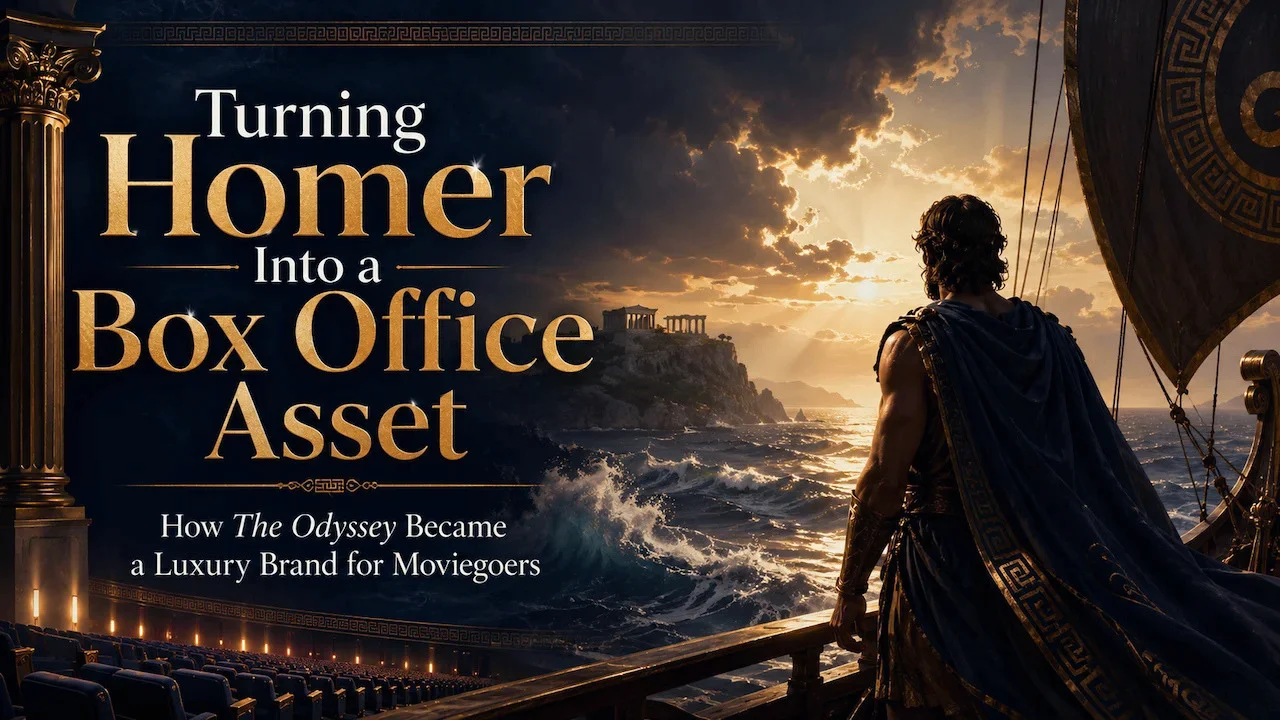
The Odyssey Luxury Brand Strategy Behind Nolan’s Epic
This article explains how Christopher Nolan’s The Odyssey is being positioned as more than a movie. It explores how premium formats, scarcity, director brand equity, star power, and theatrical exclusivity can turn an ancient story into a modern box office asset.
For readers interested in celebrity wealth, Hollywood money, entertainment business models, and brand equity, the topic matters because it shows how value is now built around experience, ownership, distribution, and cultural attention.
A 3,000-year-old poem does not sound like an obvious luxury product. Yet Christopher Nolan’s The Odyssey is being sold less like a regular studio release and more like a premium cultural event.
That is the real business story behind The Odyssey luxury brand strategy. Universal is not simply adapting Homer for modern audiences. It is packaging mythology through IMAX scarcity, Nolan’s director brand, global star power, and the kind of theatrical exclusivity that makes moviegoers feel they are buying access, not just a ticket.
The film is scheduled to open in cinemas on July 17, 2026, with Matt Damon starring as Odysseus. Reuters has described it as Nolan’s follow-up to his Oscar-winning blockbuster Oppenheimer, while official materials highlight that the film was shot entirely with IMAX film cameras.
That combination matters. In a market crowded with streaming choices, superhero fatigue, and rising ticket prices, The Odyssey is testing whether old intellectual property can become new Hollywood money when it is wrapped in prestige, scarcity, and spectacle.
Why The Odyssey Luxury Brand Strategy Matters Now?
Hollywood has always loved familiar stories. Franchises, comic books, bestselling novels, games, and sequels dominate because they reduce risk. A known title gives studios something audiences already understand.
But The Odyssey is different. Homer’s epic is not a modern franchise with toy lines, cinematic universes, or built-in sequel formulas. Its value comes from cultural permanence. The story has survived for centuries because it deals with homecoming, temptation, survival, identity, and power.
Nolan’s version turns that old cultural capital into modern brand equity. The pitch is not only “come see a Greek myth.” It is “come see a foundational story in the most premium theatrical format available.”
NBCUniversal has described the film as a mythic action epic filmed across multiple international locations and the first film shot entirely with IMAX cameras. The official movie site also promotes the July 17, 2026, release and IMAX camera production as central selling points.
That is why this project feels closer to luxury branding than standard movie marketing. Luxury is built on scarcity, craftsmanship, reputation, and emotional desire. The Odyssey uses all four.
The Business Model Behind the Money
The direct revenue model is simple on the surface. The movie earns money through theatrical ticket sales, premium-format surcharges, international box office, home entertainment sales, streaming rights, television licensing, and possible merchandising or library value.
The deeper model is more interesting. The Odyssey is designed to make the theatrical experience feel irreplaceable.
Streaming trained audiences to wait. Premium cinema tries to reverse that behavior by making the first viewing feel like the best viewing. IMAX 70mm screenings, limited seats, and opening weekend urgency all create a sense of event status.
That scarcity can support higher average ticket prices. It can also help theaters, studios, and premium format partners capture more revenue from fans who want the “correct” version of the movie.
Salary Versus Ownership
For actors, filmmakers, and producers, salary is only one part of Hollywood money. Upfront pay creates immediate income. Ownership, backend participation, producer fees, and rights participation can create longer-lasting value when a film performs well.
That does not mean every star in a major movie owns a stake in the project. Most private deal terms are not publicly confirmed. Some actors receive fixed salaries. Some may negotiate bonuses or backend based on box office performance. Producers and production companies may benefit from more complex arrangements.
The key difference is risk and upside. A salary is safer. Ownership or backend can be more valuable, but only if the movie becomes profitable under the terms of the deal.
Brand Equity and Audience Trust
Christopher Nolan’s name is one of the strongest director brands in modern Hollywood. That is brand equity in action.
Audiences do not just buy a ticket because they know Homer. Many buy because they trust Nolan to make the experience feel serious, cinematic, and worth seeing on the largest screen possible. That trust has financial value.
Oppenheimer proved how powerful that trust can be. Box Office Mojo lists the film at about $975.8 million worldwide, and IMAX said Oppenheimer was its top-grossing 2023 title with $183.2 million in IMAX global box office.
That performance changed expectations for what adult, prestige, director-led cinema could do at scale. The Odyssey is now benefiting from that halo.
Helpful Table
| Wealth Driver | How It Works | Why It Matters |
|---|---|---|
| Theatrical box office | Ticket sales from domestic and international cinemas | Creates the first major revenue wave |
| Premium formats | IMAX, IMAX 70mm, and other large format screenings | Can raise ticket value through scarcity and experience |
| Director of brand equity | Audience trust in Nolan’s name and filmmaking style | Turns the filmmaker into a marketing asset |
| Star power | Cast members bring recognition and global fan interest | Helps raise awareness across different audience groups |
| Streaming rights | Later licensing or platform release after theaters | Extends revenue beyond opening weekend |
| Library value | Long-term ownership or distribution value of the film | Can support future licensing and catalog income |
| Endorsement effect | Stars gain prestige from association with major projects | Can strengthen career leverage and brand deals |
Why Traditional Net Worth Estimates Often Miss the Full Picture?
Celebrity net worth estimates often focus on visible income. They may count salaries, reported real estate, endorsement deals, and public business ventures. But Hollywood wealth is often more complicated.
The real value can sit inside private contracts, royalties, backend deals, licensing arrangements, equity deals, production company stakes, and residual income. Taxes, agent fees, manager fees, legal costs, debt, lifestyle expenses, and investment losses also affect actual wealth.
That is why a star’s celebrity net worth is rarely a confirmed number. Publicly available data can suggest earning power, but it cannot fully reveal private investments or ownership deals unless those details are disclosed.
For a movie like The Odyssey, the same logic applies. The public can see the cast, release date, ticket demand, and box office results once available. The public usually cannot see every backend clause, profit definition, bonus trigger, or long-term rights arrangement.
Examples That Show How This Works
The clearest comparison is Oppenheimer. It was not a superhero film, a sequel, or a traditional four-quadrant fantasy franchise. It was a historical drama about J. Robert Oppenheimer, released in a theatrical market many people thought was weakening.
Yet it became a global hit. Its success showed that demand for premium formats could help turn a serious adult drama into a box-office phenomenon. IMAX said the film accounted for a major share of its 2023 box office results, while Box Office Mojo lists Universal as the domestic distributor and reports nearly $976 million in worldwide gross.
The Odyssey is building on that lesson. Early demand for premium tickets has already become part of the story. The Guardian reported that select IMAX 70mm tickets sold out a year before release, with strong demand in locations such as Melbourne, the United States, and the United Kingdom.
That kind of early demand is valuable even before final box office numbers exist. It creates headlines, signals scarcity, and tells casual audiences that the movie is an event.
The Risks Behind the Strategy
The luxury approach also raises the stakes.
A premium experience must feel premium. If audiences believe the film does not justify the ticket price, the same scarcity strategy that creates excitement can create backlash. High expectations are expensive.
There is also the risk of audience fatigue. Not every moviegoer wants a large-scale mythological epic. Some may see Homer as too distant, too academic, or too serious. Nolan himself told Reuters that the film needs to work for both people who know nothing about Homer and those who love the source material.
That is a hard balance. Make the film too faithful, and it may feel inaccessible. Make it too modern, and fans of the original may question the adaptation.
There are also normal business risks: production costs, marketing spend, release-date competition, international market performance, currency fluctuations, and the challenge of maintaining public interest until opening weekend.
Celebrity business ventures face similar problems. A famous name can attract attention, but it cannot guarantee repeat customers. The product still has to work. Whether it is a beauty brand, tequila company, fashion line, restaurant, memoir, or streaming deal, fame opens the door. Execution keeps it open.
What does this reveal about modern celebrity wealth?
The bigger lesson is that modern celebrity wealth is no longer just about salary.
Hollywood money now flows through brand equity, ownership, distribution leverage, private investments, licensing deals, royalties, residual income, and business ventures. The same idea applies to actors, directors, musicians, athletes, and creators.
Nolan’s value is not just that he directs movies. It is that his name can influence format demand, release strategy, media coverage, and audience behavior. That is a rare form of leverage in the entertainment business.
For the stars involved, appearing in The Odyssey may also strengthen long-term career value. A major prestige project can support future salary negotiations, endorsement deals, awards positioning, and public credibility. That does not mean every actor becomes wealthier in a direct ownership sense. It means that association with a high-value cultural product can increase professional leverage.
Turning Homer Into a Box Office Asset
The genius of The Odyssey luxury brand strategy is that it treats Homer as intellectual property with prestige rather than nostalgia.
The poem itself is ancient. The business model around it is modern. Scarce seats, premium formats, global stars, director trust, and theatrical urgency turn a public domain story into a commercial event.
That is why The Odyssey matters beyond one film. It could influence how studios think about classical stories, literary adaptations, and director-led cinema in a franchise-heavy market.
If it works, the lesson will not be that every old story can become a blockbuster. The lesson will be sharper: timeless material can become a box office asset when the packaging, talent, format, timing, and audience promise all align.
FAQs
Why is The Odyssey being treated like a luxury movie brand?
The Odyssey is being positioned around scarcity, IMAX presentation, Christopher Nolan’s reputation, and event-style theatrical demand. Those elements make the film feel like a premium experience rather than a standard release.
How does The Odyssey make money for Hollywood?
The film can generate revenue from theatrical box office, premium-format tickets, international distribution, streaming rights, television licensing, home entertainment, and long-term library value.
What does brand equity mean in celebrity wealth?
Brand equity is the financial value attached to a person’s name, reputation, audience trust, and cultural relevance. For celebrities and filmmakers, it can influence salaries, deals, endorsements, and business opportunities.
Why do celebrity net worth estimates miss important income?
They often cannot see private investments, backend contracts, royalties, ownership deals, taxes, debt, management fees, and undisclosed licensing arrangements. That makes exact celebrity wealth hard to verify.
Can premium formats increase a movie’s box office value?
Yes, premium formats can raise average ticket value when audiences believe the experience is worth paying more for. IMAX demand played a major role in the public business story around Oppenheimer and now shapes expectations for The Odyssey.
For more sharp breakdowns of celebrity wealth, Hollywood money, business ownership, and entertainment industry dealmaking, explore our latest celebrity net worth and entertainment business analysis articles.
Table of Contents