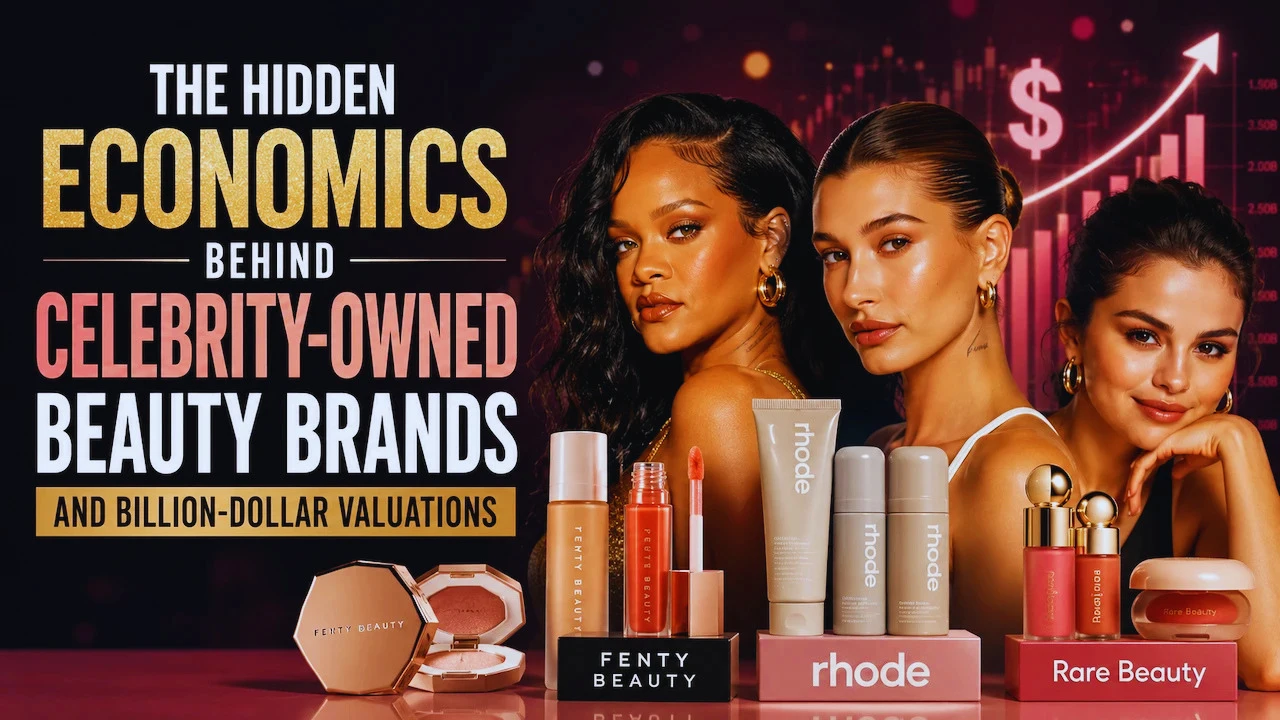
Celebrity-Owned Beauty Brands Behind Billion-Dollar Valuations
This article explains why celebrity-owned beauty brands have become one of the biggest wealth builders in modern entertainment. It breaks down how fame translates into brand equity, how ownership can outweigh endorsement income, and why billion-dollar valuations are often more complex than net-worth headlines suggest.
A celebrity beauty brand is no longer just a famous face on a lipstick tube. At its best, it is a media machine, a product company, a retail asset, and a long-term wealth vehicle rolled into one.
That is why the hidden economics behind celebrity-owned beauty brands and billion-dollar valuations matter so much. Rihanna, Selena Gomez, Kylie Jenner, Hailey Bieber, Lady Gaga, Tracee Ellis Ross, and others have shown that modern celebrity wealth is not built only through albums, films, tours, or endorsement deals. It is increasingly built through ownership.
The beauty business also has something entertainment cannot always promise: repeat purchases. A fan may stream a song many times, but a loyal beauty customer can buy foundation, blush, lip treatment, skincare, fragrance, and refills for years. That repeat behavior is what investors, retailers, and acquirers watch closely.
Why Celebrity-Owned Beauty Brands Matter Now?
The beauty market has become one of the most attractive corners of the consumer economy. McKinsey expects the global beauty market to grow about 5 percent annually through 2030, reaching around $590 billion, with social commerce and shifting shopping habits reshaping the category.
That matters because celebrities already live where beauty discovery now happens: Instagram, TikTok, YouTube, red carpets, podcasts, livestreams, and fan communities.
A traditional beauty company often has to buy attention. A celebrity founder starts with attention already built in. But attention alone is not enough. The brands that last usually combine fame with product quality, clear positioning, strong distribution, smart pricing, and an identity that feels bigger than the founder.
Fenty Beauty did this with inclusivity. Rare Beauty did it with emotional connection and mental health messaging. Rhode built a clean, edited skincare identity around Hailey Bieber’s “glazed” aesthetic. These are not just product lines. They are consumer stories.
The Business Model Behind the Money
Celebrity beauty brands can make money in several ways, but the biggest wealth usually comes from ownership.
A star can be paid to promote a product. That is an endorsement deal. The celebrity gets money whether or not the brand becomes huge, depending on the contract.
Ownership works differently. If the celebrity owns equity in the company, their wealth can rise as the business grows, raises capital, expands distribution, or is acquired by a larger company.
That is the difference between getting paid once and owning a piece of the upside.
Salary Versus Ownership
Salary is straightforward. A celebrity gets paid for work, such as acting, performing, appearing in ads, or licensing their image.
Ownership is more powerful but riskier. It can involve startup costs, management pressure, public scrutiny, and years of brand building. If the company succeeds, the celebrity’s stake may become worth far more than a single campaign fee. If it fails, the value can shrink quickly.
Kylie Jenner’s deal with Coty shows how this works. Reuters reported that Coty agreed to pay $600 million for a 51 percent stake in Kylie Jenner’s makeup and skincare businesses, valuing the company at about $1.2 billion at the time. The deal was not just about lipstick. Coty wanted access to a digitally native beauty brand, younger consumers, and Jenner’s huge social reach.
Brand Equity and Audience Trust
Brand equity is the value created by reputation, recognition, identity, and emotional connection. In celebrity beauty, it can come from several places.
A founder’s face can reduce customer hesitation. Their style can define the product universe. Their fans can create instant awareness. Their story can make the brand feel personal.
Rihanna’s Fenty Beauty is one of the clearest examples. LVMH describes the brand as created so women everywhere would feel included, with a focus on traditionally hard-to-match skin tones and formulas for different skin types.
That positioning gave Fenty more than a product hook. It gave the brand a reason to exist.
Helpful Table
| Wealth Driver | How It Works | Why It Matters |
|---|---|---|
| Salary | Upfront payment for entertainment work or campaigns | Creates immediate income |
| Endorsement Deals | Paid promotion for another company’s product | Monetizes fame without ownership risk |
| Equity | Ownership stake in a brand or business | Can grow if the company succeeds |
| Licensing Deals | Paid use of name, image, or brand identity | Creates income without full operations |
| Royalties | Ongoing payments from sales or usage | Can support long-term earnings |
| Retail Distribution | Placement in Sephora, Ulta, Target, or global channels | Turns attention into broader sales |
| Acquisition | Sale of part or all of the company | Can create a major liquidity event |
Why Traditional Net Worth Estimates Often Miss the Full Picture?
Celebrity net worth estimates can be useful, but they are rarely complete.
The problem is that many celebrity assets are private. A beauty brand may not publicly disclose revenue, profit, debt, founder ownership, investor stakes, tax liabilities, or buyout terms. A valuation is also not the same as cash in the bank.
If a brand is valued at $1 billion, that does not mean the founder personally received $1 billion. The value may be split among investors, employees, cofounders, parent companies, and shareholders. Some of it may be stock. Some may depend on future performance. Some may never fully materialize.
Rare Beauty is a good example of why caution matters. Business Insider reported Bloomberg’s estimate that Selena Gomez became a billionaire largely because of Rare Beauty. Still, Axios later noted that a reported sale process had paused and that the brand’s cap table was not publicly clear.
That does not mean the brand is weak. It means net worth math is complicated.
Examples That Show How This Works
Fenty Beauty
Fenty Beauty changed the celebrity beauty conversation because it felt product-led, not just celebrity-led. Its inclusive shade strategy gave it cultural credibility and commercial strength.
Reuters reported in 2025 that LVMH was exploring a possible sale of its 50 percent stake in Fenty Beauty, which it co-owns with Rihanna. The report said Fenty Beauty generated around $450 million in net sales in 2024 and could be valued between $1 billion and $2 billion, according to sources familiar with the matter.
The key lesson is simple: Rihanna’s wealth story is not only about performance income. It is about equity in a brand with global retail power.
Kylie Cosmetics
Kylie Cosmetics proved how quickly social media demand could become a consumer products business. The early lip kits created scarcity, urgency, and direct fan purchasing.
Coty’s acquisition of a majority stake gave Kylie Cosmetics access to broader manufacturing, distribution, licensing, and category expansion. Coty’s own announcement said Kylie and her team would continue to lead creative and communications, while Coty would handle areas such as research, manufacturing, distribution, and go-to-market expertise.
That structure shows the trade-off. The celebrity keeps the brand identity. The corporate partner scales the machine.
Rhode
Hailey Bieber’s Rhode shows the newer beauty playbook: fewer products, strong aesthetic consistency, social-first demand, and a tight founder image.
In 2025, e.l.f. Beauty announced a deal to acquire Rhode for up to $1 billion, including $800 million at closing and a potential $200 million earnout tied to future growth. Reuters also reported that Bieber would continue as founder and strategic advisor after the deal.
That earnout detail matters. It shows that big-headline valuations often depend on future performance, not just on current hype.
The Risks Behind Celebrity Beauty Brands
Celebrity beauty can look glamorous, but it is still a consumer good. The product has to work. The price has to make sense. The supply chain has to deliver. Retailers need confidence. Customers need a reason to repurchase.
The biggest risks include overexpansion, weak formulas, unclear positioning, poor shade ranges, poor customer service, founder controversy, influencer fatigue, and overreliance on a single viral product.
A celebrity name can create a first purchase. It cannot guarantee a second one.
There is also saturation. Every new celebrity brand competes against legacy companies, dermatologist-backed skincare, indie founders, K-beauty, affordable dupes, luxury houses, a nd creator-led brands. Consumers are more skeptical now. They can tell when a brand feels like a cash grab.
What does this reveal about modern celebrity wealth?
The bigger lesson is that celebrity wealth has moved from paycheck thinking to ownership thinking.
Hollywood money used to be easier to understand. A star got paid for a movie, tour, album, campaign, or TV deal. Today, the real wealth may sit in equity deals, private investments, licensing deals, royalties, residual income, intellectual property, and business ventures that do not show up neatly in public estimates.
Beauty is especially powerful because it converts identity into repeat commerce. A celebrity’s look becomes a product. A product becomes a habit. A habit becomes revenue. Revenue becomes valuation.
That is the hidden engine behind billion-dollar beauty headlines.
Conclusion
Celebrity-owned beauty brands have become one of the clearest examples of how fame can turn into long-term business value. The stars who win are not just selling products. They are building trust, owning equity, shaping culture, and partnering with companies that can scale their ideas.
The strongest brands survive because they offer more than a famous name. They have a point of view, a loyal customer base, credible products, and a business model that can grow beyond the founder’s latest viral moment.
As entertainment, commerce, and social media keep blending, the next major celebrity fortune may not come from a movie deal or record contract. It may come from a blush, serum, fragrance, or skincare brand that customers keep buying.
FAQs
Why are celebrity-owned beauty brands so valuable?
They can combine built-in audience attention, emotional trust, repeat purchases, retail distribution, and ownership upside. When the product performs well, the brand can become valuable beyond the celebrity’s personal fame.
Do celebrities make more from ownership than endorsements?
Sometimes, yes. Endorsements provide upfront income, while ownership can grow over time if the business succeeds. But ownership also carries more risk because the brand’s value can rise or fall.
Why are celebrity net worth estimates often inaccurate?
Many estimates rely on incomplete public information. Private ownership stakes, taxes, debt, investor shares, licensing terms, royalties, and deal structures are often not fully disclosed.
What makes a celebrity beauty brand successful?
The strongest brands usually have clear positioning, strong products, an authentic founder fit, smart pricing, reliable distribution, and repeat customer demand. Fame helps with awareness, but it does not replace quality.
Why do some celebrity beauty brands fail?
They fail when the product feels weak, the market is crowded, the founder seems disconnected, the pricing is wrong, or customers do not repurchase. Hype can launch a brand, but loyalty keeps it alive.
For more breakdowns like this, explore our latest celebrity wealth stories, entertainment business analysis, and net worth explainers focused on how fame becomes ownership.
Table of Contents