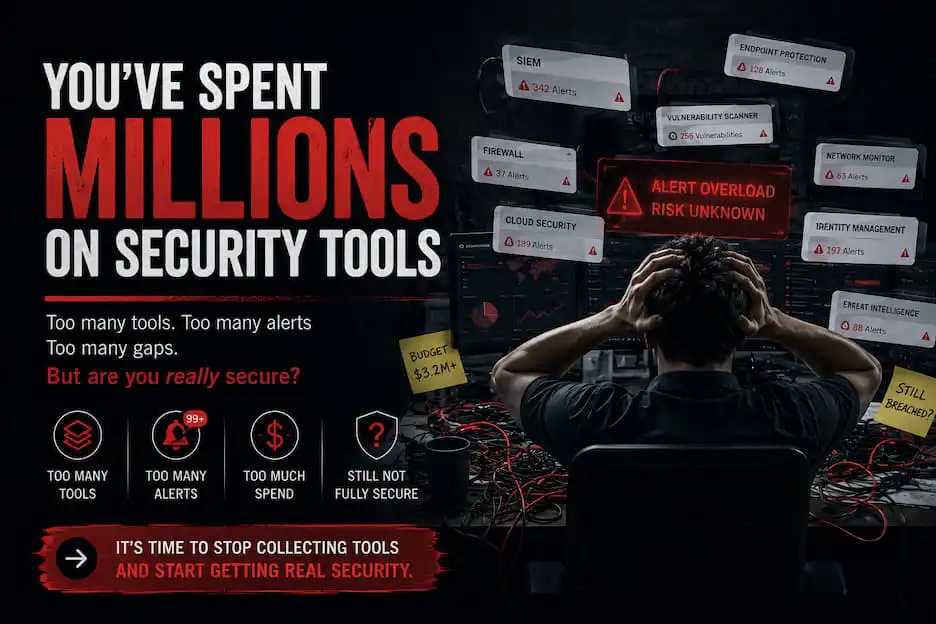
You’ve Spent Millions on Security Tools. Here’s Why You’re Still Vulnerable
Organizations are spending more on cybersecurity than ever. Security budgets have expanded, technology stacks have grown, and new platforms continue to enter the market promising better visibility, stronger protection, or faster detection. On paper, all of this should lead to safer environments.
Yet major incidents continue to affect organizations of every size. Companies with mature security programs and significant investments still discover exposed systems, overlooked vulnerabilities, or attackers moving through environments unnoticed.
That gap raises an uncomfortable question: if organizations are spending millions on security tools, why do they still end up vulnerable?
The answer usually has less to do with the tools themselves and more to do with how security operates day to day.
The Assumption That More Tools Mean Better Security
Many organizations build security programs by adding solutions over time. A phishing incident leads to a new email security platform. A cloud migration introduces cloud monitoring tools. New compliance requirements bring additional detection products into the stack.
After a few years, the environment starts to look crowded.
Large organizations regularly run dozens of security products across endpoint protection, SIEM platforms, vulnerability scanners, identity systems, cloud monitoring, and threat detection. Each tool may solve a specific problem. Put them all together, and managing the whole system becomes much harder.
Security leaders often end up dealing with overlapping capabilities, disconnected dashboards, and competing alerts. Teams gradually spend more time maintaining products than understanding actual risk.
At that point, complexity becomes a problem of its own.
Adding another tool might improve visibility in one area while creating confusion somewhere else. Integration issues, configuration drift, and inconsistent policies can quietly leave openings behind.
More technology doesn’t always mean more control.
You Can’t Protect Systems You Don’t Know Exist
Most security programs assume they have a complete picture of their environments. Reality changes much faster.
Cloud resources appear and disappear. Teams launch applications independently. Vendors receive temporary access. New APIs get introduced. Remote work expands the number of devices and locations connecting to business systems.
Security dashboards may display thousands of managed assets. That still doesn’t guarantee full visibility.
Picture a development team creating a cloud-based testing environment for a short-term project. The work wraps up, but the environment stays active. Months pass and nobody remembers it exists. Since it was never properly added to inventories, monitoring around it may be limited.
An attacker doesn’t need to fight through heavily defended systems if an overlooked one sits nearby.
This kind of situation appears more often than many organizations expect. Forgotten assets, unmanaged systems, and shadow technology create exposure that security tools never fully address because those systems never entered the process in the first place.
Weak security isn’t always the issue. Sometimes teams are working with an incomplete picture.
Alert Fatigue Changes How Teams Respond
Most security teams aren’t struggling with a lack of information.
They’re dealing with too much of it.
Analysts can receive thousands of alerts every day. Some represent legitimate threats. Others are duplicates, false positives, or low-priority findings.
When the volume becomes unrealistic to manage, people naturally adjust. Teams begin filtering aggressively. Familiar patterns get deprioritized. Repetitive alerts start blending together.
That creates a different kind of risk.
A meaningful alert can end up looking like the hundred that came before it. Small indicators that deserve attention become easier to overlook.
Think about a security analyst nearing the end of a long shift. After hours spent investigating false alarms, another notification appears. At first glance, it seems routine. Later, it turns out to be connected to a larger compromise.
That’s not necessarily a technology problem. It’s a human one.
Security tools generate information. People still have to decide what matters.
As environments grow, organizations sometimes discover that increasing detection capability without adjusting staffing or workflows creates more strain than value.
Attackers Don’t Follow Security Checklists
Organizations often structure security around controls, standards, and compliance requirements.
Those frameworks serve a purpose. They create consistency and establish useful baselines. Passing an audit, though, doesn’t automatically make an organization difficult to compromise.
Attackers aren’t thinking in categories or compliance requirements. They’re looking for opportunities.
Serious incidents rarely happen because of one issue. Problems usually emerge from combinations of weaknesses that appear harmless on their own.
An exposed login portal paired with weak authentication. A forgotten cloud resource tied to outdated permissions. A small configuration issue mixed with excessive user access.
Security tools may identify individual pieces of these problems. Sometimes what gets missed is the larger path connecting them.
Real attackers look for chains of opportunity rather than isolated findings.
Security tends to break where assumptions go untested.
Why Defensive Visibility Needs Offensive Thinking
Many organizations have started recognizing that vulnerability scans and alert collection only provide part of the picture.
Security teams increasingly add approaches that evaluate environments from an attacker’s perspective.
The goal isn’t simply identifying vulnerabilities. The bigger question is whether weaknesses can actually be exploited and how those weaknesses connect.
A vulnerability scanner may generate thousands of findings. Few organizations have the resources to fix everything immediately.
Suppose a testing exercise reveals that three minor issues can be combined to reach critical systems. Priorities suddenly become clearer.
This approach helps answer practical questions:
- Can an attacker move between systems?
- Which weaknesses create meaningful exposure?
- Where do assumptions break down?
- Which controls actually hold up under pressure?
Testing often exposes problems that were technically visible but operationally overlooked.
Organizations working with firms like Bishop Fox increasingly use offensive security assessments and adversarial testing exercises to challenge assumptions and uncover exploitable gaps before attackers do. Security tools still matter, but testing adds context that technology alone often misses.
Security Maturity Isn’t Measured by Tool Count
Large security budgets can create a sense of confidence. More products, more dashboards, and more alerts can create the appearance of stronger protection.
Strong security programs usually focus less on accumulation and more on effectiveness.
That often means simplifying environments where possible. Reducing overlap. Improving asset visibility. Testing assumptions regularly. Understanding whether controls perform under realistic conditions.
Security investments matter. Technology matters too.
Still, spending millions on tools doesn’t automatically reduce risk.
Organizations become stronger when they understand what they have, what may be missing, and where attackers are most likely to succeed.
Sometimes the biggest vulnerabilities exist in the gaps between the tools already in place.

Table of Contents