Why Ketoconazole Is Popular in Anti-Dandruff Care
Dandruff is one of those problems that feels minor until it isn’t. The flaking, the itching, the constant checking of your shoulders before a meeting — it adds up. And if you’ve spent any time looking for solutions, you’ve probably come across ketoconazole in shampoos, creams, or scalp treatments. But what exactly makes it so widely used, and does it actually work?
What Ketoconazole Actually Is
Ketoconazole is an antifungal compound that was originally developed as a prescription medication for serious fungal infections. Over time, researchers discovered that it was particularly effective against the kind of fungi that affect the scalp. Today, it’s available in lower concentrations in over-the-counter shampoos and is widely used in dermatology-recommended anti-dandruff treatments.
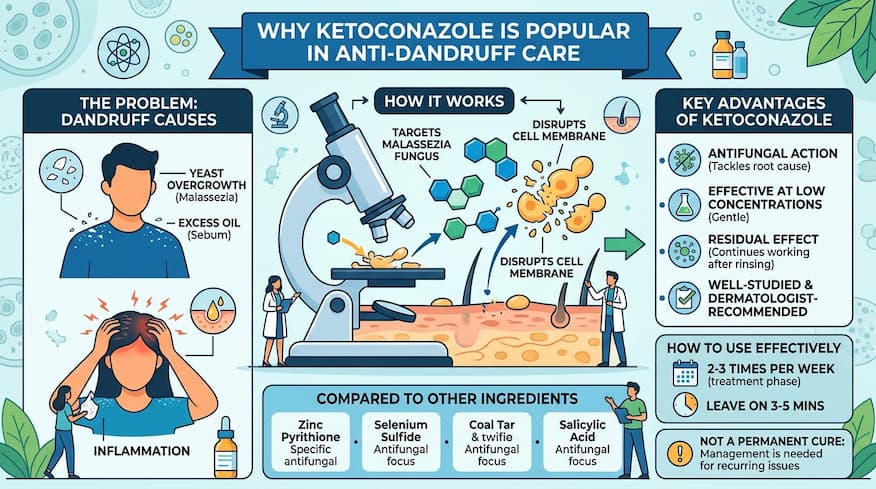
It belongs to a class of drugs called azole antifungals. The way it works is fairly specific — it disrupts the cell membrane of fungi by blocking a particular enzyme they need to survive. Without that enzyme, the fungal cells can’t maintain their structure and eventually die off.
The Connection Between Dandruff and Fungal Activity
To understand why ketoconazole is so relevant, you need to understand what actually causes dandruff in most people. The skin on your scalp, like the rest of your body, constantly sheds old cells. Normally, this process is slow and invisible. But when a naturally occurring yeast called Malassezia grows too rapidly on the scalp, it can accelerate this shedding cycle and cause inflammation.
The result is the visible flaking and itching we associate with dandruff. Malassezia feeds on the natural oils your scalp produces, which is why people with oilier scalps sometimes experience more persistent dandruff. This is not a hygiene issue — it’s a biological one.
Ketoconazole targets Malassezia directly, which is why it works better than many other ingredients that only address symptoms like flaking without addressing the underlying fungal overgrowth.
Why Ketoconazole Stands Out Among Anti-Dandruff Ingredients
There are several active ingredients used in anti-dandruff products — zinc pyrithione, selenium sulfide, coal tar, salicylic acid. Each has its place. But ketoconazole is often considered one of the most reliable for fungal-driven dandruff because of how specifically it acts on the problem.
A few things that make it stand out:
- It works at relatively low concentrations, so it’s effective without being harsh
- It has a residual effect, meaning it continues working even after rinsing
- It addresses the root cause (fungal overgrowth) rather than just exfoliating flakes away
- It’s well-studied, with clinical trials backing its use for seborrheic dermatitis and dandruff
That said, it’s not a permanent cure. If conditions on the scalp return to what they were — excess oil, warmth, certain product buildup — Malassezia can overgrow again.
How to Use It Without Over-Relying on It
One thing that often gets overlooked is that ketoconazole shampoos are generally meant to be used as a treatment, not a daily cleanser. Overusing any medicated shampoo can strip the scalp of its natural balance. The usual recommendation is two to three times per week during active flare-ups, and less frequently once things settle.
If you’re thinking about which shampoo is best for hair for your particular scalp condition, it’s worth distinguishing between shampoos designed for daily use versus those with active antifungal ingredients. Using both at different times can often give better results than relying on one product for everything.
Leave-on time also matters. Most ketoconazole shampoos are more effective when left on the scalp for three to five minutes before rinsing. Simply applying and rinsing immediately reduces the time it has to act on the fungi.
Where Root Cause Treatment Comes In
Here’s something worth knowing: dandruff doesn’t always have one single cause. For some people, it’s primarily fungal. For others, it’s linked to scalp dryness, product sensitivity, hormonal changes, or even stress affecting skin turnover. A treatment that only addresses one factor may give partial relief.
Some approaches, like the Traya Ketoconazole Shampoo, combine antifungal action with ingredients that support overall scalp health, which can be more effective for people dealing with recurring or stubborn dandruff rather than a one-time flare-up.
Final Thoughts
Ketoconazole earned its place in anti-dandruff care for a good reason — it targets the actual biological mechanism behind most cases of dandruff rather than just masking the visible symptoms. But it works best when used correctly, in the right frequency, and ideally as part of a broader understanding of what’s happening on your scalp. If dandruff keeps coming back despite treatment, that’s usually a sign that something else is contributing — and that’s worth looking into more carefully.
