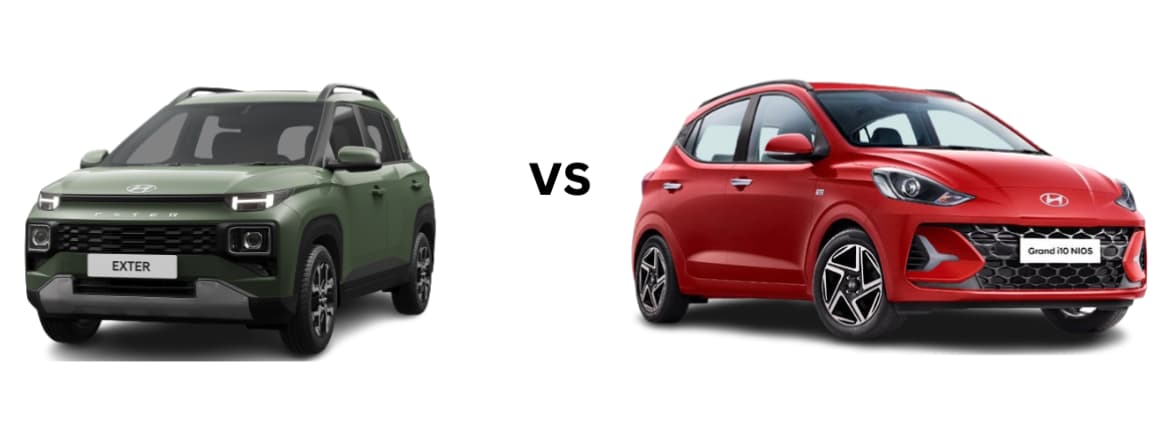
Hyundai Exter and Grand i10 Nios: Style-Driven vs Practical Buying Decisions
Car-buying decisions are increasingly influenced by factors beyond specifications and pricing. In today’s market, emotional appeal and design perception often play as much of a role as practicality. The Hyundai Exter and the Hyundai Grand i10 Nios illustrate this contrast effectively, representing two different approaches to entry-level car ownership—one driven by style and aspiration, the other by practicality and efficiency.
This distinction reflects a broader shift in how buyers evaluate vehicles.
The Rise of Style-Driven Choices
The Hyundai Exter is clearly positioned as a style-led product. Its design incorporates strong SUV-inspired elements such as:
- Bold front fascia and upright stance
- Bridge-type roof rails and wheel arch cladding
- Tall proportions with segment-leading height and wheelbase
These features create a sense of presence that goes beyond its compact dimensions.
For many buyers, especially younger audiences, such design cues foster a sense of individuality and modernity. The Exter is not just a means of transport—it becomes a reflection of personal style.
Practicality as a Core Strength
In contrast, the Hyundai Grand i10 Nios is built around practicality. Its design is more understated, focusing on functionality rather than visual impact.
Features such as:
- Compact dimensions (3,815 mm length)
- Efficient interior layout
- Ease of manoeuvrability in city conditions
make it highly suitable for everyday use.
The Nios does not attempt to stand out aggressively. Instead, it integrates seamlessly into daily routines, providing a predictable, convenient ownership experience.
Interior Experience: Expression vs Function
Inside the cabin, the difference becomes more pronounced.
The Exter offers a more expressive interior, featuring:
- Dual-tone (Navy & Grey) interior theme
- 3D carbon-pattern dashboard finish
- Spacious 391-litre boot for versatility
These elements enhance the sense of modernity and lifestyle appeal.
The Nios, meanwhile, prioritises comfort and usability. It includes:
- Well-appointed interiors with a practical layout
- Rear AC vents and adjustable seating
- Wireless charging and ergonomic controls
The focus is on delivering a comfortable environment for everyday driving rather than making a bold design statement.
Technology: Feature Appeal vs Functional Utility
Technology plays a key role in influencing buying decisions.
The Exter incorporates features such as:
- Wireless Android Auto and Apple CarPlay
- Connected car technology (Bluelink in higher variants)
- Dashcam integration (first-in-segment feature)
These features add to its appeal as a modern, feature-rich vehicle.
The Nios, while also offering essential technology like:
- 8-inch touchscreen infotainment system
- Smartphone connectivity and voice recognition
- Cruise control and steering-mounted controls
focuses on usability rather than novelty.
This reflects two different approaches: adding features to enhance appeal versus ensuring features support daily use.
Performance: Similar Capability, Different Perception
Interestingly, both vehicles share similar mechanical foundations.
The Exter offers a 1.2L petrol engine producing 83 PS, along with manual and AMT options.
The Nios uses the same engine configuration, delivering comparable performance figures.
This similarity highlights that the difference between the two vehicles is not about capability, but about how that capability is presented and perceived.
Safety: Equal Importance Across Approaches
Safety is a priority for both models.
The Exter comes standard with 6 airbags, along with over 30 safety features and advanced systems such as ESC and hill-start assist.
The Nios also offers 6 airbags, ESC, and vehicle stability management, providing a strong baseline of protection.
This parity reinforces the idea that safety is no longer a differentiator but a necessity.
Buyer Mindset: Emotion vs Logic
The choice between the Exter and Nios ultimately comes down to the buyer’s mindset.
- Buyers choosing the Exter are often influenced by style, presence, and the desire for a more expressive vehicle.
- Buyers choosing the Nios typically prioritise practicality, efficiency, and ease of ownership.
This contrast reflects a broader market trend in which emotional and rational factors coexist in decision-making.
The Role of Digital Comparison
Online car-buying platforms such as ACKO Drive allow buyers to compare vehicles across multiple parameters before making an online purchase.
In such comparisons:
- The Exter stands out for its design and feature appeal
- The Nios stands out for its practicality and usability
This enables buyers to align their choices with their priorities.
Conclusion
The Hyundai Exter and Grand i10 Nios represent two distinct approaches to entry-level car buying. One emphasises style and aspiration, while the other focuses on practicality and reliability.
As buyer preferences continue to evolve, both approaches are likely to remain relevant—serving different needs within the same market.
Table of Contents