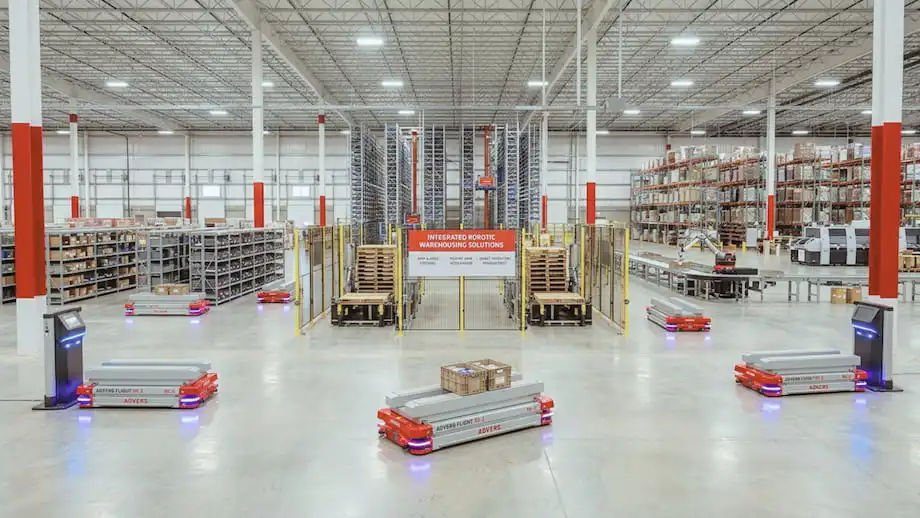
How Robotic Warehousing Solutions Are Being Adopted in Tier-2 and Tier-3 Cities in U.S.
Warehouse operations in the USA are not confined to the major logistics hubs any longer. The continuous expansion of regional fulfilment networks means that Tier-2 and Tier-3 cities are becoming increasingly significant for supply chain operations. Warehouses are now being set up close to consumers in order to optimise delivery efficiency. This shift is creating new opportunities for warehouses outside traditional logistics centres.
Consequently, robotic warehousing solutions are attracting more interest among logistics providers in these growing markets. Advancements in robotics, flexibility in application, and availability have ensured that automation becomes an accessible choice for many more warehouses. Unlike before, when firms would concentrate their investments in large distribution centres, they now look to develop regional warehouse capacity, which will allow them to scale sustainably without compromising operational efficiency.
Why Is Robotic Warehouse Adoption Growing in Tier-2 and Tier-3 U.S. Cities?
The growth in the presence of regional logistics networks is among the major factors driving the uptake of robotic systems within Tier-2 and Tier-3 locations in the USA. Companies have moved closer to their customers by positioning stock closer to them so that they can deliver their products within a shorter period. The rise in logistics centres has made operators search for technologies to ease operations right from the beginning.
Fulfilment strategies from regional areas are another reason for the rising interest in automation. Facilities within these regions have increasing numbers of orders, and they need to remain reliable. Robotic warehousing has become accessible, leading many to rely on it to improve their capacity while eliminating manual work. With changing customer demands, automation has become an essential element of business development plans.
How Are Regional Warehouses Deploying Robotics to Support Growth?
Regional warehouses are leveraging the power of robotics technology to handle the repetitive and laborious tasks that could affect productivity when done manually. The adoption of robotics makes it possible for operators to enhance efficiency in work processes as well as boost production levels without necessarily increasing warehouse size.
Some of the ways warehouses are using robotics include:
- Automating routine material movement activities
- Supporting higher order volumes without major facility expansion
- Improving operational consistency across warehouse processes
- Responding more effectively to changing customer expectations
These implementations assist warehouses in the USA in maximising their capacity utilisation while retaining room for future development.
What Business Drivers Are Accelerating Robotics Adoption in Regional Warehouse Markets?
Availability of labour is another factor that has been causing trouble for some warehouses in regional markets. Most warehouses find it difficult to recruit workers who are able to perform physically rigorous tasks. Robotics can be employed to minimise reliance on physical labour while allowing employees to focus on higher-value activities within warehouse operations.
Improvement in productivity is yet another key factor. Companies have been forced to enhance their efficiency, retain their service quality, and keep their costs in check with growing order volumes. In addition, many companies want to be able to scale up their operation without proportionally raising the number of employees. This trend has resulted in increased automation investment in the Tier-2 and Tier-3 USA-based warehouses.
Which Robotic Warehousing Solutions Are Seeing the Highest Adoption?
Robotics of different types are increasingly being adopted based on operational needs and the processes within the warehouse facility. One type of robot that is becoming very popular is the Autonomous Mobile Robot (AMR), as it allows flexible transportation without any major infrastructural modifications.
Other commonly adopted solutions include:
- Robotic picking systems that improve fulfillment efficiency
- Robotic sorting technologies that support order processing
- Automated storage solutions that enhance inventory management
- Integrated robotics ecosystems that connect multiple warehouse functions
Many companies are also using warehouse automation solutions that integrate robotics, software, and material movement systems to make their operations more interconnected. Through such an approach, the efficiency of warehouses is enhanced.
How Addverb Supports Warehouse Automation Across Emerging Logistics Markets
Addverb offers a range of robotic warehouse solutions aimed at meeting the demands of dynamic operations in regional logistics environments. These solutions comprise AMRs, AS/RS, sorting systems, and warehouse management software, all of which contribute to warehouse efficiency and scalability. This approach allows organisations to expand warehouse automation capabilities based on operational requirements and future growth objectives.
Addverb concentrates on combining robotics, software, and material movement technology to achieve connected automation environments. Such an approach allows warehouses to automate processes in warehouses gradually in line with the requirements and growth objectives. Through its modularity, Addverb supports the gradual adoption of robotics in warehouses in line with a warehouse’s long-term business plans.
Conclusion
There has been a steady rise in the number of businesses embracing robotic warehousing in Tier-2 and Tier-3 cities in the USA as more and more fulfillment centers develop. The pressure to deliver faster, issues regarding labor shortages, and operational efficiency goals are encouraging businesses to invest in warehouse robotics and automation technologies.
As supply chains become more distributed, there is a need for scalable technologies that will enable growth while maintaining high performance standards. The robotics and automation technologies offered by Addverb help warehouses meet this requirement, since these scalable technologies promote growth and improvements in efficiency in new logistics sectors within the USA.

Table of Contents