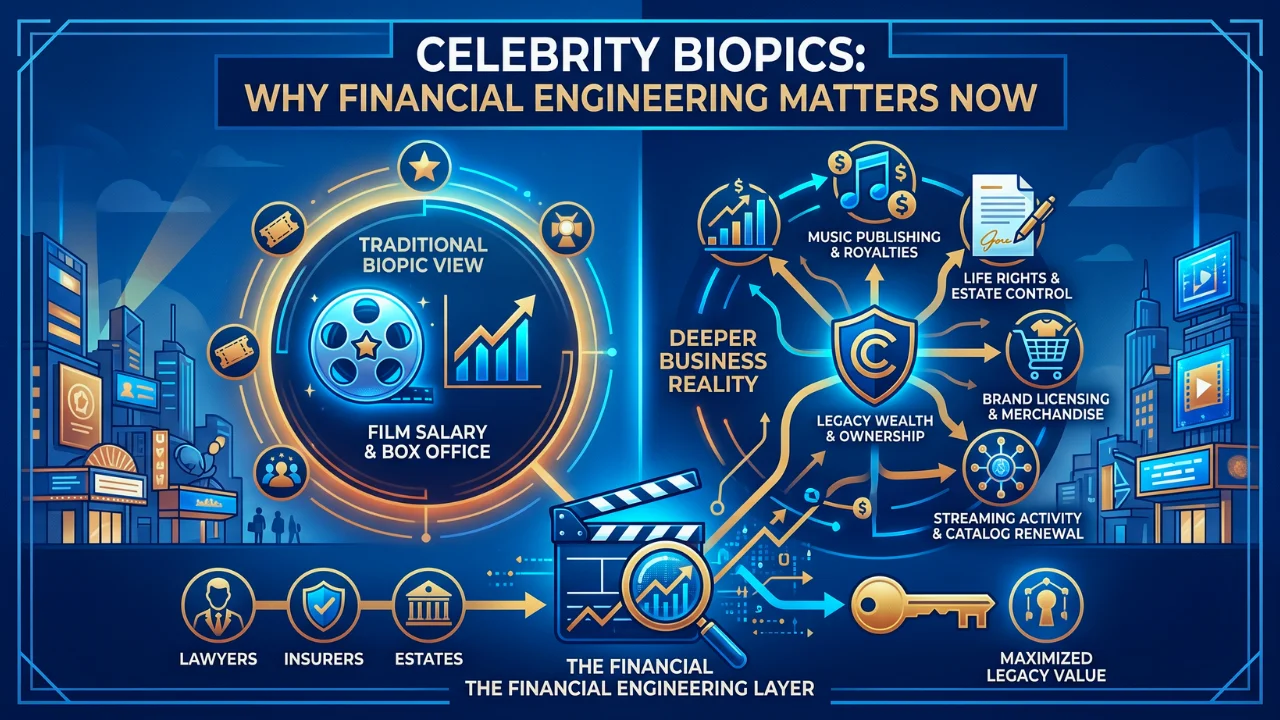
Why Celebrity Biopics Need Serious Financial Engineering Now
This article explains why celebrity biopics are financially more complicated than ordinary sequels. It breaks down rights, royalties, licensing, estate control, liability risk, and why celebrity net worth estimates often miss the deeper business story behind legacy entertainment.
A sequel usually begins with a known asset. A celebrity biopic begins with a person’s life, and that is where the money gets complicated.
That is why celebrity biopics require more financial engineering than sequels. A studio can build a sequel around characters, scripts, box office history, and franchise demand. A biopic has to balance memory, music, estates, publicity rights, legal exposure, fan expectations, and the emotional value of a real human legacy.
For entertainment business readers, the real story is not only whether a film sells tickets. It is who controls the underlying assets after the movie revives public attention.
Why This Celebrity Wealth Trend Matters Now?
Celebrity biopics have become valuable because fame now spans more income streams than ever. A successful film can drive streaming activity, soundtrack interest, merchandise demand, documentary licensing, stage rights, social media conversation, and renewed brand partnerships.
That matters in a music economy where catalog rights have become serious financial assets. IFPI reported that global recorded music revenue reached $31.7 billion in 2025, with streaming accounting for about 70% of recorded music income. That makes old songs, familiar names, and legacy fan bases especially attractive to rights holders.
Sequels usually monetize familiar fiction. Celebrity biopics monetize identity. That means the financial model may involve a studio, producers, music publishers, record labels, estates, heirs, managers, insurers, lawyers, and brand partners.
The movie is only one layer. The bigger prize can be a refreshed celebrity brand.
The Business Model Behind the Money
A biopic earns money through familiar film channels such as box office, streaming rights, international distribution, television licensing, and home entertainment. But the extra financial engineering comes from the assets surrounding the subject.
For a musician, that can include publishing rights, master recordings, soundtrack deals, performance clips, archival footage, name and likeness rights, merchandise, and stage show potential. For an actor, athlete, entrepreneur, or public figure, the package may involve life rights, trademarks, endorsement history, book rights, brand partnerships, and family approval.
This is why the deal structure matters. A film that looks like a normal drama may actually be a layered rights transaction.
Salary Versus Ownership
An actor’s salary is simple compared with ownership. Salary is the upfront payment for work. Ownership is participation in future value.
In a biopic, ownership can sit in many places. The estate may control name and likeness rights. A music publisher may control songs. A label may control recordings. A producer may hold film rights. A distributor may own certain release windows. The celebrity’s heirs may benefit from royalties, licensing deals, or backend participation, depending on the terms of any confirmed contracts.
That is very different from a sequel, where the studio often already controls the core intellectual property.
Brand Equity and Audience Trust
A celebrity’s name carries brand equity. Fans may want more than just a movie. They want a version of the person that feels emotionally true.
That trust has financial value. It can sell tickets, revive old albums, introduce younger audiences to a catalog, and make licensing deals easier. It can also create risk. If the film feels sanitized, exploitative, inaccurate, or disrespectful, the backlash can damage the brand it was meant to protect.
The strongest biopics usually work because they are more than nostalgia. They make the audience feel that the legacy is still alive, while giving business partners a reason to invest in that legacy again.
Why Traditional Net Worth Estimates Often Miss the Full Picture?
Celebrity net worth estimates rarely show the full structure behind celebrity wealth. Public sites may capture visible income such as film salaries, tour revenue, endorsements, or real estate. They often cannot confirm private investments, undisclosed equity deals, debt, taxes, management fees, estate planning, royalty splits, or licensing contracts.
Biopics make this gap even wider. A celebrity may not personally receive all the money connected to a film. Income might flow to an estate, a trust, a label, a publisher, a production company, or multiple rights holders.
That is why celebrity wealth is not the same as celebrity net worth. Wealth can include control, catalog value, brand equity, residual income, and future licensing leverage. Net worth estimates are often snapshots. Biopic economics are more like a moving balance sheet.
That shows how this works
The clearest example is the music biopic. Bohemian Rhapsody became a major box-office success, grossing over $900 million worldwide, according to Variety. But its broader business value also came from renewing Queen’s cultural presence for a new generation.
Elvis showed a similar pattern. Box Office Mojo lists the 2022 film at about $287.7 million worldwide, but the larger impact was brand revival, renewed conversation around Elvis Presley’s influence, and fresh attention for a legacy catalog.
Bob Marley’s ” One Love also showed how a biopic can turn legacy music into a contemporary theatrical event. AP reported the film opened at No. 1 with $27.7 million over its debut weekend, despite mixed critical reaction.
These examples do not prove that every biopic is safe. They prove that when rights, timing, casting, marketing, and audience emotion align, a biopic can become more than a film release. It can become a brand reset.
The Risks Behind Celebrity Business Ventures
The risk profile is where celebrity biopics differ most from sequels.
A sequel can fail because the story is weak or the audience is tired. A biopic can fail because the rights are incomplete, the family disagrees, the music is unavailable, the portrayal feels unfair, or old controversies resurface.
Life rights are not always legally required, but entertainment lawyers often note that buying them can reduce risk, improve access to private materials, and help with claims involving defamation, privacy, or publicity rights.
Right of publicity is another major issue. It protects against unauthorized commercial use of a person’s name, likeness, voice, or other identity markers, depending on the jurisdiction.
Insurance also matters. Some entertainment law guidance notes that obtaining cooperation and permissions can affect errors and omissions coverage, which is important when a film depicts real people, private events, or disputed history.
That is why a biopic can become expensive before cameras roll. The budget is not only for production design, cast, and marketing. It is legal clearance, research, insurance, negotiation, music licensing, estate management, and reputational protection.
Helpful Table
| Wealth Driver | How It Works | Why It Matters |
|---|---|---|
| Salary | Upfront payment for acting, producing, or consulting | Creates immediate income but may not capture long-term upside |
| Royalties | Ongoing payments from music, books, or creative works | Can create residual income long after release |
| Licensing | Paid use of name, image, music, footage, or brand | Allows monetization without direct operation |
| Equity | Ownership stake in a company, film entity, or venture | Can grow if the asset increases in value |
| Streaming Rights | Distribution value from platforms and digital windows | Extends earning potential beyond theaters |
| Brand Equity | Public trust, cultural relevance, and fan loyalty | Can lift merchandise, catalog demand, and future deals |
| Estate Control | Management of posthumous rights and assets | Shapes how legacy wealth is protected or monetized |
What This Reveals About Modern Celebrity Wealth
Celebrity wealth is no longer just about salaries, music sales, box office bonuses, or sports contracts. The bigger story is ownership.
A celebrity brand can behave like intellectual property. It can be licensed, refreshed, protected, packaged, and sold across platforms. That is why biopics attract studios, estates, investors, music companies, and brand strategists.
But the upside only works when the financial structure is strong. Without rights clearance, audience trust, legal protection, and a credible creative approach, the same legacy that creates value can become a liability.
Celebrity biopics are not cheaper versions of sequels. They are emotional asset deals wearing the clothes of prestige entertainment.
Conclusion
Celebrity biopics require more financial engineering than sequels because they are built on real lives rather than fictional worlds. Every famous name comes with assets, permissions, memories, risks, and stakeholders.
For celebrities, heirs, estates, and investors, the value is not limited to ticket sales. The deeper opportunity sits in royalties, licensing deals, streaming rights, residual income, and long-term brand equity.
The next wave of Hollywood money will not only belong to the franchises with the biggest explosions. It will also belong to the legacies that can be managed with care, accuracy, and smart ownership.
FAQs
Why do celebrity biopics need more financial engineering than sequels?
Celebrity biopics involve life rights, music licensing, estate approval, publicity rights, insurance, and reputational risk. Sequels usually start with intellectual property already controlled by a studio.
How do celebrity biopics make money?
They can earn from box office sales, streaming rights, soundtrack revenue, international distribution, licensing deals, merchandise, and renewed demand for related catalogs or brands.
Why are celebrity net worth estimates often incomplete?
They may not include private investments, taxes, debt, royalty splits, estate structures, licensing terms, management costs, or undisclosed equity deals.
What is brand equity in celebrity wealth?
Brand equity is the financial value of public trust, recognition, fan loyalty, credibility, and cultural relevance attached to a celebrity’s name or image.
Why do some celebrity biopics fail?
They can fail due to weak storytelling, poor casting, rights disputes, music clearance issues, family opposition, public backlash, or audience fatigue.
Explore more celebrity wealth stories, entertainment business breakdowns, and net worth analyses to understand how fame translates into long-term financial power.

Table of Contents