What Is IAM? A Complete Guide to Identity and Access Management in Cybersecurity
Compromised credentials play a role in roughly 22% of confirmed data breaches worldwide, according to SentinelOne’s 2026 Data Breach Report. Look behind almost any major breach headline, and you’ll usually find the same root cause: someone got access they shouldn’t have had. That’s exactly why identity and access management has moved from a quiet back-office IT function into something closer to a central pillar of business security. This guide answers what IAM is, walks through how IAM in cybersecurity actually works day to day, and uses real examples along the way so business owners, IT teams, and the just plain curious can see why this field matters so much right now.
What Is IAM?
IAM stands for Identity and Access Management. Put simply, it’s the set of policies, processes, and technology a business uses to make sure the right people, and only the right people, get access to the right systems, apps, and data at the right time. Every time an employee checks their email, opens a shared drive, or logs into a company app on their phone, an IAM system is quietly checking who they are and what they’re allowed to see.
A decent comparison is a hotel key card. Not every guest gets into every room. A guest’s card opens their own room, maybe the gym or pool, but not the manager’s office or the room next door. IAM works much the same way inside a company’s digital environment. It hands out “keys,” meaning access rights, based on someone’s role, and it can pull those keys back the second someone changes roles or leaves the company.
Why Identity and Access Management Matters So Much
The numbers back this up pretty clearly. Microsoft’s 2025 Digital Defense Report found that more than 97% of identity attacks rely on some form of password compromise, and identity-based attacks jumped 32% in just the first half of 2025. IBM’s Cost of a Data Breach Report found something similar: breaches involving compromised credentials cost businesses an average of $4.67 million and take roughly 246 days to even identify and contain, considerably longer than most other breach types.
Here’s a scenario that plays out more often than people think. A mid-sized accounting firm never got around to deactivating a former employee’s account after they left. Months later, that same login shows up accessing client financial records, because nobody remembered to remove it. This is precisely the kind of oversight a properly managed IAM system prevents, since access gets revoked automatically the moment someone’s employment status changes.
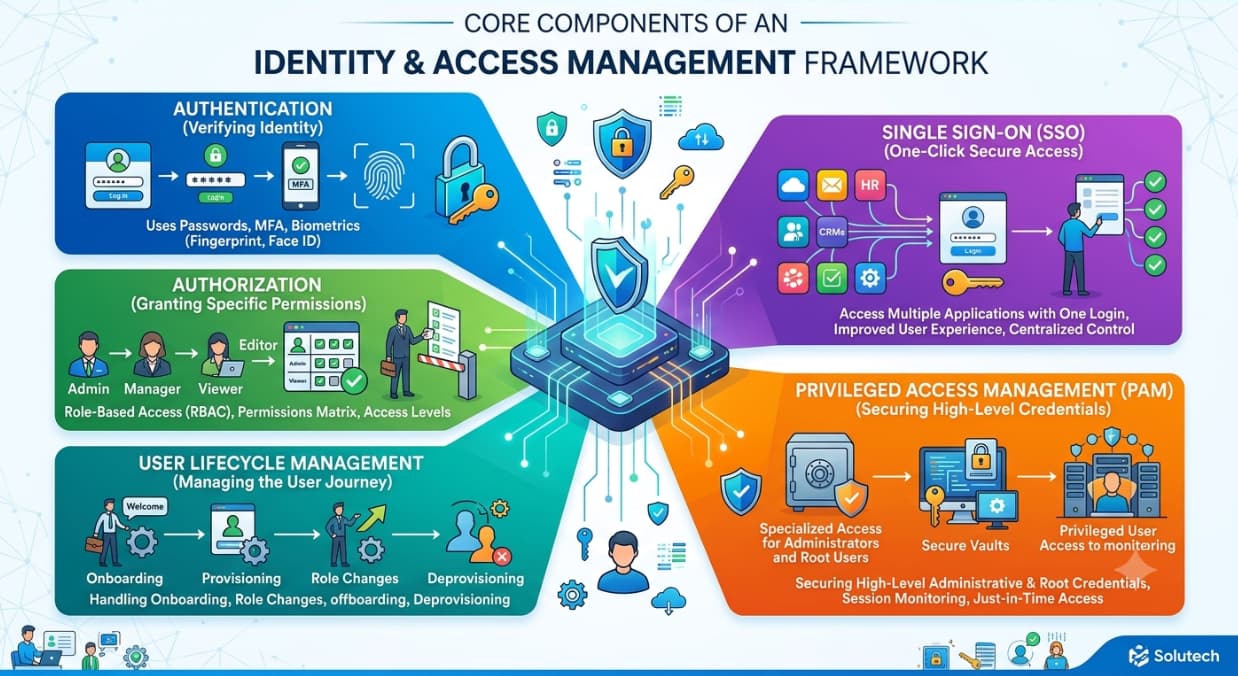
Core Components of Security Identity and Access Management
Image Alt tag :Components of Identity and Access Management
Security identity and access management really comes down to a handful of core building blocks.
1. Authentication
Authentication confirms someone is who they say they are. It usually starts with a username and password, though relying on passwords alone has turned out to be risky. Password-only setups are tied to the overwhelming majority of identity compromises, which is why so many organizations have layered in multi-factor authentication, requiring a second form of verification like a text code, authenticator app, or fingerprint. A bank employee logging in from a new laptop, for example, might get asked to confirm their identity through a one-time code sent to their phone, adding a checkpoint beyond just the password.
2. Authorization
Once someone’s identity is confirmed, authorization decides what they’re actually allowed to do. A marketing coordinator might have access to social media tools and campaign folders, but nothing near payroll systems or source code. This is often called “least privilege access,” and the idea is simple: employees get only the access they genuinely need for their job. Nothing more.
3. User Lifecycle Management
This covers the full journey of a digital identity, from someone’s first day to their last. When a new hire starts, IAM systems can set up their accounts and grant the right access automatically based on their role. When someone switches departments, access shifts with them. And when they leave, access gets pulled immediately, closing a gap attackers exploit surprisingly often.
4. Single Sign-On (SSO)
Single sign-on lets employees log in once and reach every approved application without typing credentials over and over. Beyond the convenience, it cuts down on the number of passwords employees have to juggle, which means fewer weak, reused passwords born out of sheer frustration.
5. Privileged Access Management (PAM)
Some accounts carry a lot more risk than others, particularly ones belonging to system administrators or executives with broad access to sensitive systems. PAM adds extra monitoring, approval steps, and time-limited access to these high-value accounts, since a compromised admin account can do far more damage than a compromised standard one.
How IAM in Cybersecurity Works in Practice
Picture a hospital network to see IAM in cybersecurity in action. Doctors need access to patient records, but only for patients under their own care. Billing staff need insurance and payment info, not clinical notes. IT administrators need broad system access, but ideally only during scheduled maintenance windows. An IAM system enforces all of these boundaries automatically, and it logs every access attempt along the way, which gives the hospital a clear audit trail for meeting healthcare privacy regulations and investigating anything unusual quickly.
Cloud adoption has raised the stakes here too. As businesses spread across platforms like AWS, Microsoft Azure, and Google Cloud, along with dozens of connected SaaS apps, the number of digital identities needing management has grown substantially. Some researchers project that non-human identities, APIs, automated bots, and connected devices will eventually outnumber human user accounts by more than three to one in large enterprises. Every one of those machine identities needs its own access rules, which is exactly why a structured IAM approach has stopped being optional.
The Business Case for Investing in IAM
The global IAM market was valued at roughly $26.8 billion in 2025 and is projected to keep growing steadily, which reflects how seriously organizations now take this corner of security. This growth isn’t just about buying more software. It reflects a real shift in how companies think about protecting their data. A well-run IAM program reduces the odds of a costly breach, helps meet compliance requirements like GDPR or HIPAA, and honestly just makes life easier for employees who no longer have to juggle a dozen separate logins.
Worth mentioning: many financial institutions now use adaptive authentication, where the system looks at the context of a login attempt, location, device, time of day, and only asks for extra verification when something looks off. That balances solid protection with a smooth experience for employees and customers going about their normal day.
Getting Started with IAM
Businesses just starting their IAM journey usually begin with a few foundational steps: cataloging every system and app holding sensitive data, defining clear roles and what access each one actually requires, rolling out multi-factor authentication everywhere, and automating onboarding and offboarding so nothing slips through the cracks. From there, many layers of single sign-on and privileged access controls for their most sensitive systems.
Conclusion
Identity and access management has become one of the most practical, cost-effective ways for organizations to cut down their overall cyber risk. Answering what IAM is clearly and understanding how its core pieces, authentication, authorization, lifecycle management, and privileged access, work together gives business leaders a much better footing for protecting their most valuable digital assets. As IAM in cybersecurity keeps maturing alongside cloud computing, remote work, and a growing sea of connected devices, the organizations that invest early in strong identity practices put themselves in a far better position to prevent breaches, satisfy regulators, and hold onto the trust of both customers and employees.Paramount helps organizations strengthen their identity and access security with practical cybersecurity solutions designed to support evolving business and regulatory requirements.

Table of Contents