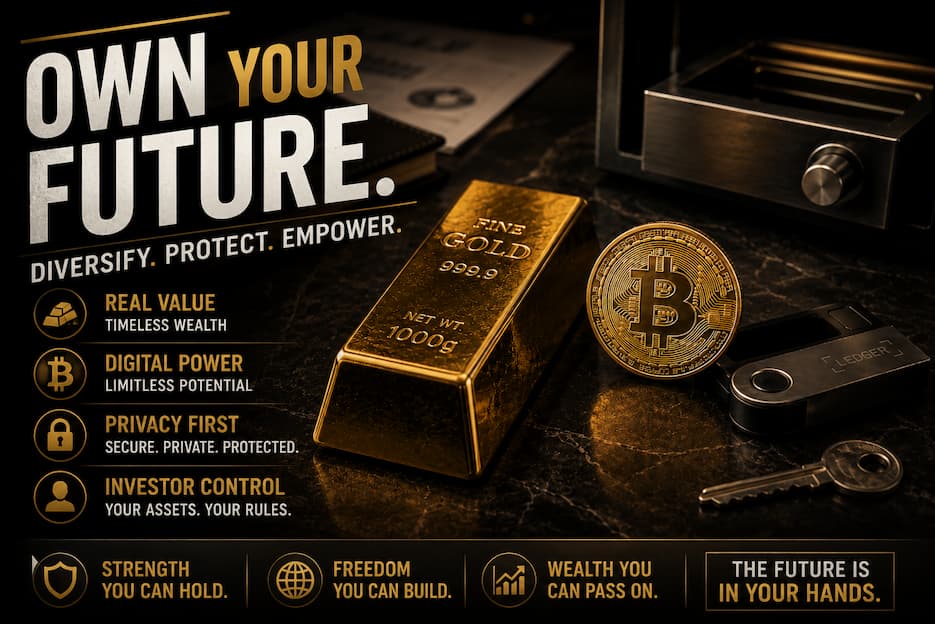
The Future of Alternative Assets: Gold, Bitcoin, Privacy, and Investor Control
Alternative assets were once explained to ordinary investors in fairly simple terms. They were the portion of a portfolio expected to behave differently from stocks and bonds: a hedge against inflation, a buffer during market stress, or a source of diversification when conventional assets moved together. That case still exists. It is just no longer enough.
The sharper question is control. Who holds the asset? Who can restrict access? What remains if a platform fails, a bank changes its policy, or a government tightens capital rules?
This is why gold and Bitcoin keep returning to the same conversation, even though they are very different instruments. Neither is a business with quarterly earnings. Neither is a bond promising future payments. Both appeal to investors who are uneasy with the idea that wealth should exist only as a balance inside someone else’s system.
The future of alternative assets may therefore be less about choosing a single winner and more about understanding what kind of ownership an investor actually wants.
Why Gold Still Matters in a Digital Financial System
Gold’s appeal begins with a fact that sounds almost old-fashioned: it is physical. It is not a payment app, a brokerage account, a software protocol, or a promise issued by a company. A bar or coin still has to be stored, insured and authenticated, but it does not need a password to exist.
That quality has helped gold retain its role in a highly digital financial system. According to the World Gold Council, global gold demand reached 1,231 tonnes in the first quarter of 2026, while the value of demand rose to a record $193 billion. Central banks bought 244 tonnes on a net basis in the same quarter. These numbers do not prove that gold will outperform other assets. They do show that demand for an asset outside the usual credit structure remains strong.
For private investors, the logic is more practical. Physical gold does not pay interest and does not generate earnings. Its value comes from scarcity, recognition and the absence of issuer risk. It is often held for the part of the future that cannot be forecast neatly.
There are real limitations. Physical gold involves storage costs, dealer spreads and verification. A gold ETF is easier to trade, but it is not identical to direct possession. A mining share carries company and operating risk. A futures position is a contract, not a coin in a vault. The label “gold exposure” can hide very different forms of risk.
Bitcoin and the New Meaning of Portability
Bitcoin answers a different concern. It is not simply gold translated into digital form. It is a decentralized monetary network with a predictable issuance schedule and a native asset that can be transferred globally at the network level without a traditional bank.
That portability is central to its appeal. Bitcoin can be held by an individual through private keys, moved across borders and settled without relying on the normal banking rails. For investors who worry about financial gatekeepers, this is not a minor feature. It is the thesis.
But direct control has a cost. Self-custody gives the holder technical control over the asset, yet it also transfers responsibility for security. Lost keys, phishing, poor backup practices, weak inheritance planning or a compromised device can turn autonomy into permanent loss. In Bitcoin, mistakes are often final.
Regulated investment products have changed the market. In January 2024, the U.S. Securities and Exchange Commission approved the listing and trading of several spot Bitcoin exchange-traded product shares. Fidelity Digital Assets later described 2026 as a year of accelerating integration between digital assets and traditional capital markets. For many investors, that integration makes Bitcoin easier to access.
Access, however, is not the same as ownership.
A Bitcoin fund can provide price exposure. A custodial platform can provide convenience. A private wallet can provide direct technical control. Each structure solves one problem and creates another. Treating them as equivalent is one of the easiest ways to misunderstand the asset.
Exposure Is Not Ownership
The same distinction applies across alternative assets. A person can own exposure to gold without holding physical gold. A person can own exposure to Bitcoin without controlling Bitcoin. A brokerage account, ETF, vault, exchange, trust or private wallet can all produce different outcomes in a crisis.
In calm markets, the difference often feels academic. Investors tend to prefer clean statements, quick execution, tax documents and familiar interfaces. Convenience has a strong argument when everything works.
Stress changes the calculation. Can withdrawals be delayed? Are assets segregated? What is the legal claim? Who controls the keys? Who audits the vault? What happens if the intermediary becomes insolvent or the rules change?
Alternative assets are not automatically independent just because they sit outside stocks and bonds. A hard asset held through a weak structure may still leave the investor dependent on the weakest party in the chain. Custody is no longer an administrative detail. It is investment risk.
Privacy Is Becoming an Investment Question
Privacy is the most difficult part of the debate because it carries both legitimate and uncomfortable associations.
Gold has long been linked with financial discretion, but even physical ownership is not invisible. Dealers, vaults and large transactions are subject to compliance rules that vary by jurisdiction. Still, gold can offer a degree of practical separation from fully digital financial infrastructure.
Bitcoin is often misunderstood in the opposite direction. It is not anonymous by default. Public blockchains such as Bitcoin and Ethereum are transparent ledgers. Cambridge Judge Business School has warned that permanent visibility on public blockchains creates legitimate privacy concerns, including commercial confidentiality, personal financial privacy and protection from surveillance.
That transparency can be useful. It supports auditing and gives investigators tools that do not exist in the same way with cash. It can also expose more than users expect. If a wallet address is linked to a real identity, past and future activity may become readable to analysts, competitors, data firms, criminals or political actors.
This is why the more constructive privacy discussion is not about disappearing from the financial system, but about limiting unnecessary exposure. A carefully designed private swap can help separate routine transfers from a user’s broader wallet history, provided it works within responsible compliance standards rather than outside them.
None of this removes the enforcement problem. Reuters reported, citing Chainalysis, that money launderers received at least $82 billion in cryptocurrencies in 2025. That helps explain why regulators continue to focus on mixers, sanctions evasion and illicit flows.
The privacy debate is therefore not a simple contest between good users and bad regulators. Nor is it only a story of crime. It is a struggle over the boundaries of financial visibility in a digital economy.
Regulation, Compliance and the Search for a Middle Ground
The market is unlikely to accept either extreme for long. Total opacity is not compatible with mainstream finance. Total surveillance weakens one of the reasons alternative assets attract investors in the first place.
A more likely outcome is somewhere less neat: stronger custody standards, better wallet infrastructure, clearer proof that assets are actually held, and more practical thinking around inheritance and recovery. These details may sound secondary, but they are where the idea of investor control becomes real – or proves to be mostly rhetoric.
That middle ground is already shaping how the industry talks about crypto privacy tools. The strongest argument for them is not absolute secrecy, but better control over what financial information becomes public, traceable or unnecessarily exposed.
For gold, the key questions are physical and legal. Where is it stored? Who audits it? How quickly can the holder access it? What rights does the investor have if the storage provider fails?
Investors do not have to choose the most radical form of independence. The real question is whether they understand the trade-off when they choose simplicity.
Gold Versus Bitcoin Is the Wrong Question
Gold and Bitcoin will continue to be compared because both sit outside the usual logic of stocks and bonds. Both are scarce. Both are used by some investors as stores of value. Both attract people who distrust excessive reliance on fiat money and centralized institutions.
Yet the comparison can become lazy. Gold offers physical finality. Bitcoin offers digital portability. ETFs offer convenience. Self-custody offers autonomy. Banks offer service. Vaults offer separation. Each model solves one problem while creating another.
The next phase of alternative assets will probably not produce a single dominant answer. It will produce a more segmented market. Some investors will want liquidity above all else. Some will want privacy. Some will prefer regulated products. Others will accept complexity for direct control.
The useful question is not whether gold is better than Bitcoin, or whether Bitcoin will replace gold. It is what form of financial independence an investor is actually trying to build.
The Future of Alternative Assets
The future of alternative assets will be shaped by price, but not by price alone. Trust, custody, privacy and access will matter just as much.
A gold investor must decide between easy market exposure and physical possession. A Bitcoin investor must decide between custodial convenience and self-custody. A privacy-focused investor must decide how much visibility is acceptable. An institution must balance compliance with clients’ demand for autonomy.
These choices affect where assets are stored, how they are transferred, how they are reported, how heirs can access them and what happens when a platform, custodian or government changes the rules.
In calm markets, convenience usually looks rational. During stress, custody suddenly matters.
That is why alternative assets should not be judged only by charts. The better test is whether the structure of ownership matches the investor’s real concern. For some, that concern is inflation. For others, it is counterparty risk, portability, privacy or control.
Gold and Bitcoin may remain rivals in market commentary. In practice, they are two different answers to the same deeper anxiety: how much of one’s wealth should depend on institutions, and how much should remain directly under the investor’s control?
FAQ
Are gold and Bitcoin direct competitors?
Not exactly. Gold offers physical finality, while Bitcoin offers digital portability and the possibility of self-custody. They can serve different roles in an alternative asset strategy.
Why does custody matter for alternative assets?
Custody determines whether an investor has direct control or only price exposure through an intermediary. That difference can become critical during market stress.
Is Bitcoin private?
Not in the way many people assume. Bitcoin does not show names on the blockchain, but its transactions are publicly visible. That transparency can be useful for verification and investigations, yet it also means that financial activity may become exposed once a wallet address is connected to a real person or business.
Why do investors still buy physical gold?
Physical gold remains attractive because it is tangible, globally recognized and not issued by a government, bank or corporation. Its appeal is strongest when investors care about control as well as return.
Table of Contents