Most organizations treat the chatbot decision as a sourcing question. It is rarely that simple. You are choosing where operational intelligence will reside once the system begins interacting with real users.
A production chatbot is an adaptive system. Intent models drift as language evolves, retrieval pipelines depend on changing knowledge bases, and confidence thresholds quietly influence customer outcomes. The complexity does not sit in the launch sprint. It accumulates in the hundreds of micro-adjustments made after deployment, each one informed by context that is partly technical and partly institutional.
Hiring internal talent concentrates that context inside your walls, along with retention risk and tooling obligations. Outsourcing distributes execution but externalizes judgment about tone, thresholds, and edge cases, which is central to the in-house vs outsourced chatbot development debate. Over time, those judgments compound.
The decision is less about capability at build time and more about where you want system memory to live when there is no supervision, whether you hire chatbot developers internally or rely on AI chatbot development services.
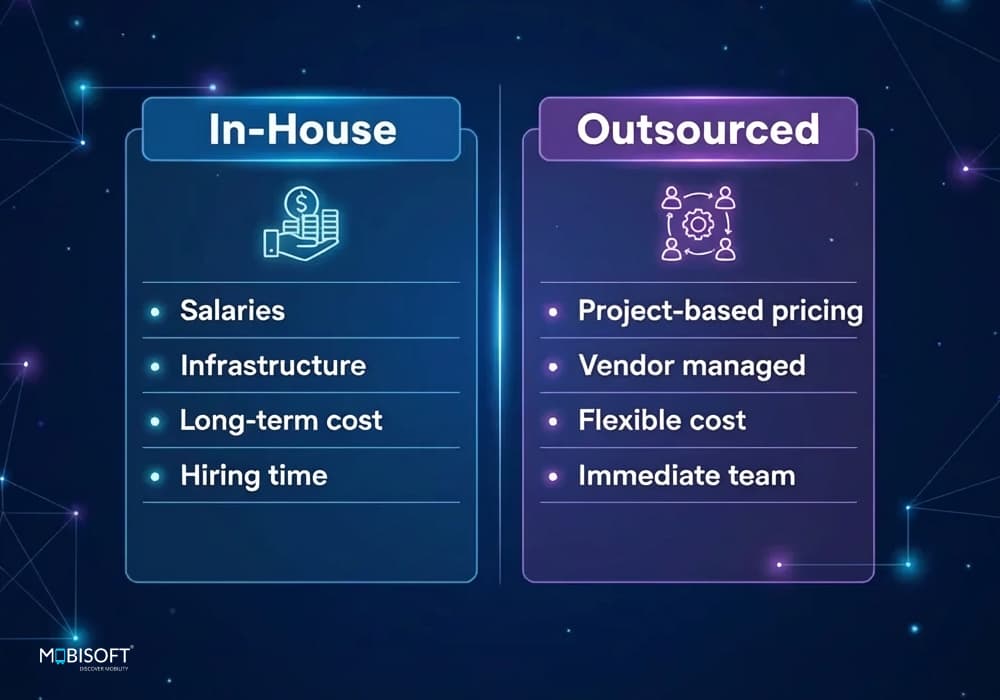
Control vs Access in Development
-
Institutional Memory Risk
The salary is visible and budgeted. What remains invisible until it happens is the institutional memory loss when a key engineer departs. An NLP developer who has spent eighteen months tuning your chatbot carries undocumented knowledge about why certain utterance patterns were routed to fallback handlers, and where the integration layer accommodates quirks in your customer data platform that the official documentation does not acknowledge
-
AI Talent Mobility
Production AI talent in 2026 faces no unemployment risk. Engineers with demonstrated experience deploying conversational systems receive continuous inbound interest. This is not a forecast about your specific retention efforts. It is a structural condition of the labor market.
-
Builder vs Architect Gap
There is a distinction between an engineer who can build a working chatbot and one who can architect a maintainable system. The former is easier to hire and easier to identify. The latter produces less visible output in the first six months but prevents the accumulation of unmanageable technical debt. Hiring the builder without the architect results in a system that passes acceptance criteria but requires disproportionate effort to modify later, which often influences the broader build vs buy chatbot solution evaluation.
-
Incomplete AI Stack
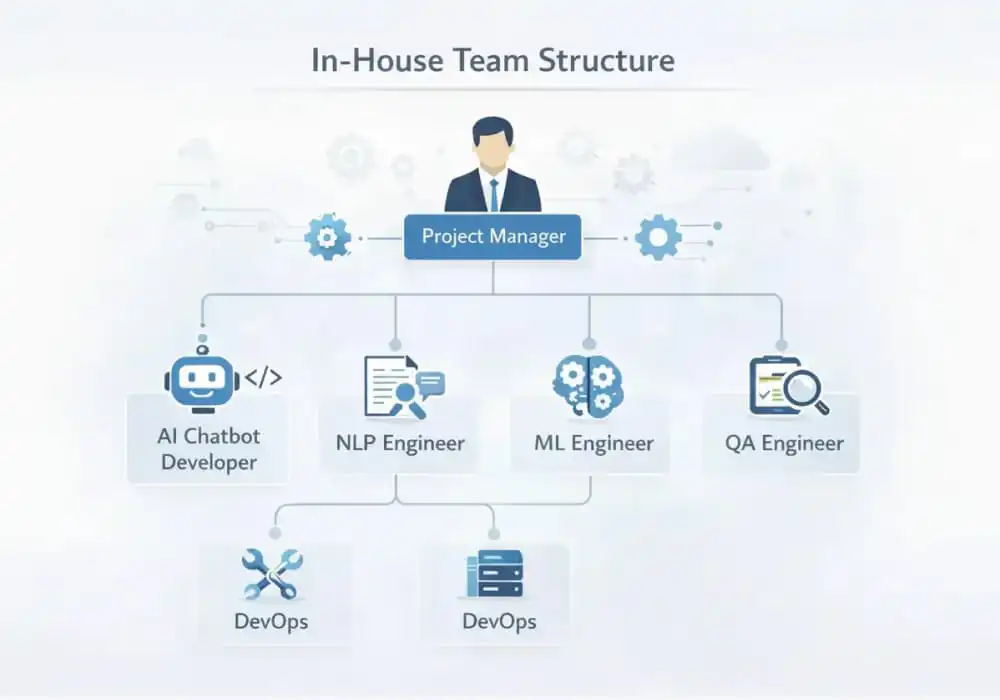
In-house chatbot development requires more than a developer. It requires model monitoring to detect performance drift, data versioning to support reproducible training, and deployment automation to move changes safely. Organizations that hire chatbot developers without provisioning this surrounding capability have hired a component, not a function.
Internal development becomes economically rational when the chatbot constitutes a core product differentiator, when conversation behavior directly generates revenue or defends against churn, and when the organization is prepared to staff a team rather than a role.
Hiring Chatbot Developers: The Tradeoffs
-
Control Without Insight
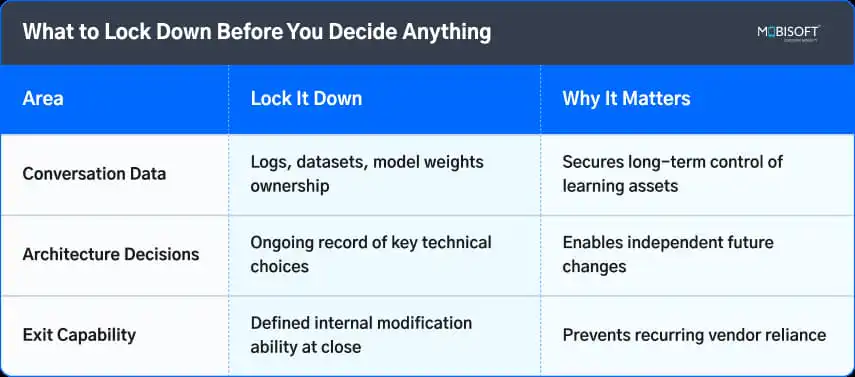
Most companies discover ownership is not binary during the first unexpected modification request. You possess the repository credentials but cannot explain why the model responds the way it does or which dependency breaks during an upgrade. Ownership of an artifact is not ownership of insight.
-
Code vs Context
In-house, you receive code and embedded reasoning for as long as the developer stays. When they depart, the operational knowledge departs with them. Outsourced, you receive a completed system, but the vendor retains architectural logic, training rationale, and edge case maps. You hold the keys. They hold the understanding. This structural gap defines much of the in-house vs outsourced chatbot development decision.
-
Missing Control Layers
Troubleshooting context does not transfer. The improvement roadmap does not transfer. Self-serve modification capability does not transfer. These are not line items on any contract, but they determine whether you control the system or merely host it, whether through internal hiring or AI chatbot development services.
-
Ownership Clauses
Define ownership before week one to include decision logs, architectural rationales, and competency criteria. For a hire, documentation requirements are written into role expectations. For a vendor, acceptance is tied to knowledge transfer. Ownership is what you can exercise without calling the person who built it.
If you are evaluating whether to hire chatbot developers or outsource, explore the full scope of capabilities required before committing to a model.
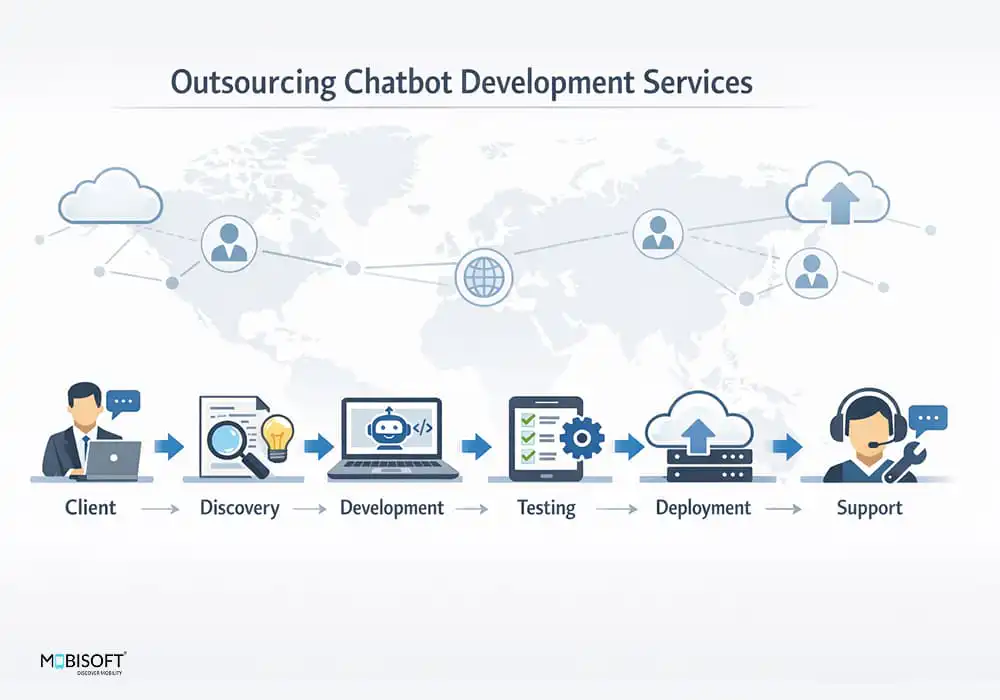
Vendor Dependency in Chatbot Projects
-
Context Reconstruction Gap
A chatbot sits at the intersection of your brand voice, your data architecture, your user behavior patterns, and your compliance obligations. This context cannot be serialized into a requirements document. The vendor receives your brief and attempts to reconstruct an environment they have never inhabited, even when working with experienced AI chatbot development services providers. Some fidelity loss is inevitable. The question is how much you can afford to lose.
-
Cumulative Micro Choices
Every sprint, the outsourced team makes dozens of small judgments. How to classify an ambiguous utterance. Where to set the confidence threshold. Which response variant better reflects your stated tone? These decisions are made in isolation from your daily organizational context. Collectively, they produce a system that reflects the vendor’s interpretation of your business instead.
-
Vendor Re-Onboarding Cost
When you need to modify the system post-launch, you do not resume a relationship. You initiate a procurement. The vendor must reassign personnel, rediscover the architecture, and reconstruct the reasoning behind the original decisions. Apart from time and money, the biggest expense is the context you rebuild with them each time.
-
Schedule Over Learning
Vendors are measured against milestones, not against the depth of their product learning. Their optimization function rewards functional delivery on schedule. It does not reward investment in understanding your customers’ linguistic patterns or your internal political constraints. This is not vendor failure. It is incentive alignment. The system arrives on time, but the contextual richness that would enable rapid evolution does not.
Outsourcing is structurally appropriate when the scope is bounded, when the use case is stable, and when you employ a strong internal product owner who holds institutional context and actively manages the vendor.
Signals That Clarify the Decision
Most organizations already possess the data that determines which dependency tax they can afford. They simply have not learned to read it as decision intelligence. These signals separate the path that compounds from the path that serves:
- If the chatbot needs frequent updates after launch, outsourcing becomes expensive. You pay to re-explain the system every time you need to change it.
- If the scope is fixed and the chatbot will mostly stay as built, outsourcing handles that cleanly. The context tax never compounds.
- A product owner with real authority and time to manage the vendor makes outsourcing viable. That person holds the institutional context that the vendor lacks.
- If ownership is diffuse and nobody singly owns the outcome, you probably need to hire chatbot developers. Vendors cannot serve a committee well.
- Proprietary training data that contains customer conversations or internal knowledge should stay internal. You cannot outsource what you cannot share.
- Regulatory requirements around data residency or sovereignty are a hard stop. The legal boundary is also the architectural boundary.
- If your definition of done is deployment and handover, outsourcing fits. If it is an independent modification capability within twelve months, hire chatbot developers or sequence.
- First AI project with no NLP experience on staff should outsource the initial build. You are not ready to hire expertise that you cannot yet evaluate through an AI chatbot development company.
- An existing MLOps function makes hiring viable. Without it, you are hiring a developer without a development environment to support them.
- If conversation behavior is a commodity capability, outsource. If it is how you differentiate your product, hire chatbot developers and own it.
The Sequential Hybrid Model
The conventional reading of hybrid is simultaneous. A vendor team working alongside your new hires, co-developing from day one. In practice, it often produces role confusion, duplicated effort, and two groups waiting for the other to own the hard problems. The version that actually works is sequential:
- Outsource the first build explicitly as a learning engagement. You are purchasing a working system and the education required to eventually operate without the vendor.
- Assign internal staff to shadow the development process actively. They should attend sprint reviews, review pull requests, and question architectural choices while the vendor is still in contract.
- Define the ownership transfer milestone at contract signing, not at project close. Specify what capabilities your team must possess, not just what software must be delivered.
- The vendor’s documentation obligation should include decision rationales, not just architecture diagrams. Your team needs to understand why things were done this way, not merely how they were assembled.
- After delivery, operate the system jointly for a defined period. Your team handles modifications with vendor oversight before attempting independent changes.
- The sequence typically runs twelve to eighteen months. Outsource months one through nine. Co-manage months ten through fifteen. Your team assumes full ownership in month sixteen, especially if the long-term strategy is to hire chatbot developers internally.
- This model fails when the outsourced team is treated as a black box, and the internal team receives only a deployed system with no insight into its construction. You must extract understanding continuously, not await it at handover.
Strategy Over Short-Term Savings
Do not reduce this decision to cost per sprint or time-to-launch. Decide where you are willing to carry accumulated understanding.
Every conversational system becomes a record of choices: which intents deserve priority, which edge cases are tolerated, which customer signals trigger escalation. Those choices either live inside your organization or remain partially external, accessible through contracts and calls. Over time, that distinction determines how quickly you can correct errors, pursue new use cases, or respond to regulatory and market pressure.
If conversation logic sits close to revenue, risk, or product differentiation, build the capability to own it. If the use case is bounded and unlikely to evolve, buy execution and manage it tightly. Sequence deliberately if you must.
Choose the dependency you can sustain when leadership changes, engineers depart, and the chatbot still needs to learn. Before finalizing your approach, align the technical model with a broader AI strategy consulting roadmap to ensure long-term scalability and governance.
Key Takeaways
- The hire versus outsource decision is a choice between talent dependency and context dependency. Neither is avoidable.
- Ownership of source code does not equal ownership of system understanding. Documentation is not optional in either model.
- In-house development creates fragility. When an engineer departs, undocumented architectural reasoning departs with them.
- Outsourcing creates recurring context costs. Every modification requires re-purchasing knowledge you already paid for in chatbot development services engagements.
- High change frequency and proprietary data signal hire. Stable scope and strong product ownership signal outsourcing.
- Hybrid works as a sequence, not a parallel activity. Outsource to build capability. Hire chatbot developers to own it.
- Your definition of done determines the appropriate model. Deployment is a vendor milestone, while independent extensibility is an organizational capability.
- The decision should be made with your 24-month organization in mind, not your 8-week deadline. Dependency compounds, so choose which interest rate you can service.
Frequently Asked Questions
How do you verify a vendor will actually transfer knowledge rather than just deliver software?
Contract payment milestones should include documented decision rationales and internal team competency assessments, not just functional software. Hold back a percentage until your team demonstrates independent modification capability without vendor assistance.
What questions should you ask an in-house candidate to assess whether they are an architect or just a builder?
Ask how they approach trade-offs between development speed and long-term maintainability. Request a retrospective on a previous system they built: what would they structure differently now and why. Architects articulate constraints. Builders describe features.
Can outsourcing work if your organization lacks a dedicated product owner but has strong vendor governance processes?
Governance processes approve or reject work. They do not generate the contextual judgment required for conversation design and model behavior decisions. Without a product owner holding the institutional context daily, the vendor operates with partial information regardless of how rigorous your approval workflow is.
How do you evaluate whether an internal candidate will document their reasoning adequately before they are hired?
Incorporate documentation expectations into the role description and interview scenarios. Present a past project and ask the candidate to explain how they would document it retrospectively. The willingness to articulate reasoning is observable. The belief that documentation is someone else’s job is also observable.
What contractual language prevents a vendor from claiming ownership or reuse rights over your conversation data and derived training artifacts?
Explicitly define conversation logs, utterance variants, model weights, and fine-tuned checkpoints as work products for which you hold exclusive ownership. Prohibit training on your data to improve the vendor’s platform models unless separately negotiated. Standard NDAs and IP clauses rarely cover derivative training artifacts explicitly.
How should you structure the initial engagement if you know you want to insource after twelve months, but your leadership insists on a fixed-price contract?
Negotiate time and materials for the first phase with a not-to-exceed cap rather than a pure fixed price. Fixed pricing incentivizes vendors to minimize discovery and documentation. You need the opposite incentive. Pay for time and require visible knowledge work.
Table of Contents