Ahead of Its Anticipated IPO, SpaceX Eyes Faster Entry Into Major Indexes
SpaceX, which recently completed a merger with Elon Musk’s AI startup xAI, is taking active steps to list on the stock exchange in a way that maximizes shareholder value. The company’s consultants approached index providers, including Nasdaq, with a proposal to accelerate SpaceX’s inclusion in leading stock indices. Usually, newcomers wait several months before entering the S&P 500 or the Nasdaq 100, but the company intends to bypass the standard deadlines to open access to liquidity and institutional capital immediately after the SpaceX IPO. It is estimated that the company is ready to go public with a valuation of $1 trillion, making it the largest IPO in U.S. history.
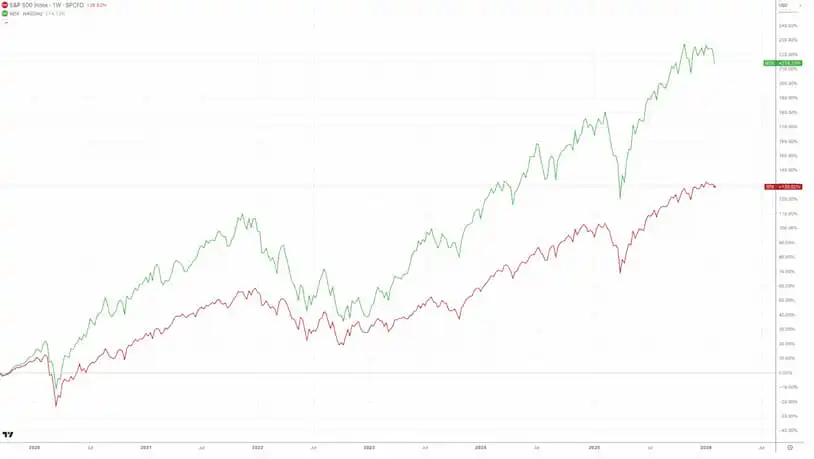
Discussions with index operators also affect other promising startups, such as OpenAI and Anthropic, which are expected to be listed on the stock exchange this year. The proposals include a quick entry procedure for companies with high market capitalization, reducing the inclusion period in the Nasdaq 100 to 15 trading days from the usual 3 months. The only obstacle remains the S&P 500, which requires the company to be based in the United States, be profitable, and have a market capitalization of at least $22.7 billion.
The rapid inclusion of SpaceX in major stock indices can significantly alter both the dynamics of trading in its shares and the logic of listing on a stock exchange for large private companies. Entering the indices in a short time will automatically lead to an influx of funds from index and ETF funds, which will have to buy SpaceX securities regardless of valuation and market conditions, thus supporting quotes in the first months after the IPO and reducing the risk of a sharp correction at the end of the lock-up period.
For other companies of the OpenAI or Anthropic scale, this sets a precedent, as entering an exchange with high capitalization and quick access to passive capital may become the new norm, shifting the balance in favor of already large and well-promoted players and at the same time increasing the entry barrier for lesser-known issuers who will still have to go through the traditional probation period outside of indices.
At the same time, SpaceX is actively developing its Starlink division, which accounts for up to 80% of the company’s profits. Last year, Starlink generated about $8 billion in net profit on revenue of $15-16 billion. Musk plans to expand the service to include satellite telephony, direct internet access from smartphones, and Stargaze space tracking technology. The latter will enable monitoring of low Earth orbits, providing data to satellite operators and government agencies, including the Pentagon and the Office of Space Commerce.
In addition, SpaceX is considering developing a mobile device that connects directly to the Starlink satellite network. According to Musk, it will be optimized exclusively for neural networks with maximum performance per watt. The development of the Starlink phone remains at an early stage, but its implementation will be a logical continuation of the company’s strategy to integrate satellite communications with consumer technologies.
In this context, SpaceX has entered into an open conflict with Amazon. The latter has submitted a request to the U.S. Federal Communications Commission (FCC) to extend the launch dates for half of the Project Kuiper satellites. In response, SpaceX said Amazon’s request was an attempt to secure special treatment and violated the principles of equal access. The company’s lawyers stressed that license extensions are only possible in case of force majeure, and Amazon’s delays are the result of its own decisions. SpaceX suggested qualifying the request as a modification of the plan to avoid radio interference for Starlink, which already serves more than 9 million users worldwide.
Thus, SpaceX is simultaneously preparing for a record IPO, expanding the profitable Starlink business, and protecting its position in orbit from competitors, demonstrating Musk’s ambitions to integrate space technologies, AI, and consumer services.