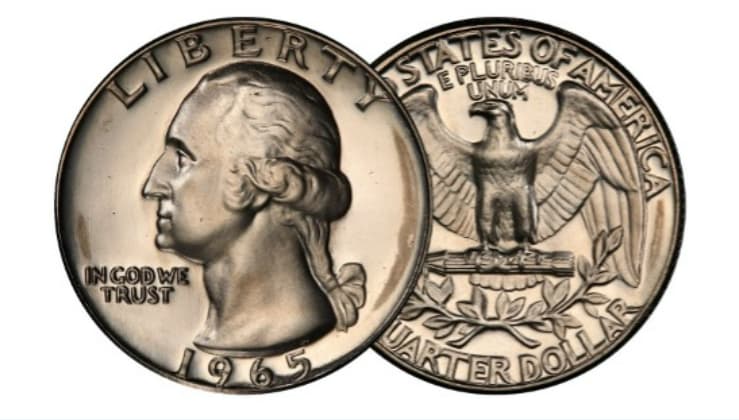
The 1965 quarter error list contains some of the most sought-after coins in American numismatics, with values ranging from a few dollars to over $16,000. This year marked a historic transition when the U.S. Mint switched from 90% silver to copper-nickel clad composition, creating unique opportunities for valuable minting mistakes.
Accurate identification is crucial for coin collectors, as many errors are difficult to spot with the naked eye. The difference between a common quarter and a $16,800 treasure often comes down to precise details that require expert knowledge. Coin value app like CoinKnow can help you identify these errors instantly, provide professional grading, and determine accurate market values.
Rare 1965 Quarter Error List & Value
1. 1965 Quarter Silver Transitional Error
This is the holy grail of 1965 quarter errors. During the composition change from silver to clad, a few leftover 90% silver planchets from 1964 accidentally made it into the 1965 production line. These coins were struck with the 1965 date but on the wrong metal composition.
Value Range: $5,000 to $16,800+ depending on condition. An MS62 specimen sold for $16,800 in December 2020.
How to Identify: The easiest method is weighing your coin on a precision scale. Silver quarters weigh 6.25 grams, while normal clad quarters weigh 5.67 grams. You can also check the edge—silver quarters show a solid silver edge with no copper stripe, unlike clad coins that display a visible copper core between nickel layers.
Need help identifying this error and checking its value? CoinKnow offers instant AI-powered identification, professional grading, and real-time market valuations. This coin value app can verify whether you have a genuine silver transitional error within seconds.
2. 1965 Quarter Doubled Die Obverse Error
Doubled die errors occur when the die receives a misaligned impression during the hubbing process. On 1965 quarters, this creates visible doubling on the obverse (front) of the coin. Look for duplicate images on “IN GOD WE TRUST,” “LIBERTY,” the date, and Washington’s profile.
Value Range: $300 to $1,650. A 1965 DDO FS-102 in MS65 condition commanded $1,650 at auction. Lower-grade examples (AU58) have sold for around $360.
Identification Tips: Use a magnifying loupe or microscope to examine the lettering closely. True doubling appears as distinct notches or overlapping letters, not simple machine doubling or shelf marks. The most valuable varieties show strong, clear doubling across all text elements.
Need help identifying this error and checking its value? CoinKnow offers instant AI-powered identification, professional grading, and real-time market valuations. This coin value app’s advanced technology can distinguish between valuable doubled dies and common circulation damage.
3. 1965 Quarter Off-Center Strike Error
Off-center errors happen when the coin blank isn’t properly aligned in the press during striking. The design gets shifted, creating a dramatic visual error. The value depends on two key factors: the percentage of off-center displacement and whether the date remains visible.
Value Range: $50 to $800+. Dramatic strikes showing 50%+ displacement with a visible date command premium prices. Minor off-center strikes (10-20%) typically bring $50 to $150.
What to Look For: Examine whether the design is shifted uniformly. Authentic off-center strikes show a crescent-shaped blank area opposite the displaced design. The date visibility is crucial—coins with readable dates are significantly more valuable than those without.
Need help identifying this error and checking its value? CoinKnow offers instant AI-powered identification, professional grading, and real-time market valuations. This coin value app can assess the displacement percentage and provide accurate pricing based on date visibility.
4. 1965 Quarter Wrong Planchet Error (Struck on Penny Blank)
This fascinating error occurred when a quarter die accidentally struck a copper penny planchet instead of a quarter blank. The result is a coin much smaller and lighter than a standard quarter, with distinctive copper coloring.
Value Range: $600 to $1,500. The exact value depends on strike quality and how well the quarter design transferred to the smaller penny blank.
Identification Features: These errors are relatively easy to spot. They weigh approximately 3.11 grams (like a penny) versus 5.67 grams for normal quarters. The coin displays a distinct red or brown copper tone, and parts of the quarter’s design may be missing due to the smaller planchet size.
Need help identifying this error and checking its value? CoinKnow offers instant AI-powered identification, professional grading, and real-time market valuations. This coin value app can confirm wrong planchet strikes and distinguish them from damaged or altered coins.
5. 1965 Quarter Struck on Dime Planchet Error
Even rarer than the penny planchet error, some 1965 quarters were struck on silver dime blanks. This created an undersized quarter with potential silver content, combining two valuable error characteristics in one coin.
Value Range: $7,000+ in Mint State condition. The rarity of this error makes it highly desirable among serious collectors.
How to Verify: These coins are approximately the size of a dime but bear the quarter design. They’re significantly lighter than regular quarters and may show the reeded edge characteristic of dimes. Professional authentication is strongly recommended for suspected wrong planchet errors of this type.
Need help identifying this error and checking its value? CoinKnow offers instant AI-powered identification, professional grading, and real-time market valuations. This coin value app’s database includes rare wrong planchet varieties and provides authentication guidance.
6. 1965 Quarter Die Break and Cud Error
Die breaks occur when cracks develop in the coin die during extended use. When metal fills these cracks during striking, it creates raised lines or blobs (called “cuds”) on the finished coin. Major die breaks affecting significant design portions are collectible errors.
Value Range: $50 to $300. Value depends on the size and location of the die break. Dramatic cuds affecting lettering or Washington’s portrait command higher prices than small edge breaks.
Identification Guide: Look for raised, unstruck metal areas on your coin’s surface. These appear as blob-like protrusions, often along the rim. Die cracks show as raised lines across the coin’s surface. The larger and more dramatic the defect, the more valuable the error.
Need help identifying this error and checking its value? CoinKnow offers instant AI-powered identification, professional grading, and real-time market valuations. This coin value app can evaluate die break severity and provide current market pricing.
How Much is a 1965 Quarter Worth? Coin Identifier I Recommended
If you’re serious about identifying and valuing 1965 quarter errors, having the right tools makes all the difference.
CoinKnow stands out with the tightest grading accuracy available—within a 2-point range on the Sheldon Scale. It automatically detects rare errors including doubled dies, off-center strikes, and wrong planchet varieties. The app offers exclusive features like copper color designation detection and proof finish identification. With daily free scans and comprehensive collection management tools, CoinKnow is ideal for collectors who want precision identification of valuable varieties.
CoinValueChecker excels at providing comprehensive market intelligence. Beyond basic identification, it offers rare error detection, market trend analysis, price tracking, and auction monitoring features. The app includes sophisticated trading insights and collection management tools, making it perfect for collectors who want both identification capabilities and in-depth market analysis to track their investments over time.
Both apps provide instant identification and professional-grade grading, but your choice depends on whether you prioritize grading precision or market intelligence features.
Table of Contents