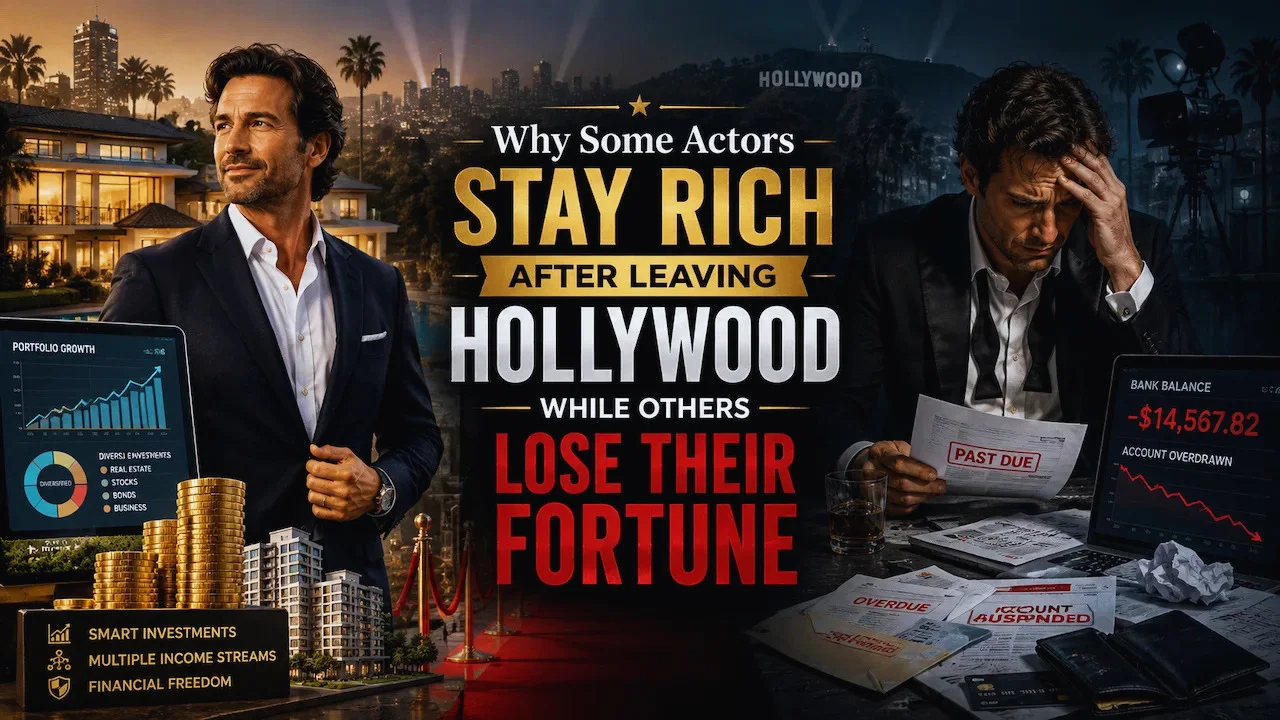
Why Actors Stay Rich After Leaving Hollywood, and Others Lose
This article explains why some actors stay wealthy after stepping away from Hollywood while others struggle financially despite years of fame. It breaks down the differences among salary, ownership, royalties, licensing, private investments, residual income, and brand equity in modern celebrity wealth.
Fame can make an actor rich, but it does not always keep them rich.
That is the uncomfortable truth behind why some actors stay rich after leaving Hollywood while others lose their fortune. A blockbuster paycheck can look enormous from the outside, yet long-term wealth depends on what happens after the cameras stop rolling.
Some actors turn attention into ownership, production companies, brand equity, licensing deals, real estate, royalties, and private investments. Others rely too heavily on upfront salaries, expensive lifestyles, weak advisers,s or business ventures that never find a real market.
The difference is not just talent. It is structured. Hollywood money rewards visibility, but lasting celebrity wealth is usually built through control, discipline, and smart timing.
Why This Celebrity Wealth Trend Matters Now?
Hollywood has changed. Actors no longer depend only on movie salaries, television contracts,s or box office bonuses. Streaming, social media, direct-to-consumer brands, private equity, and celebrity entrepreneurship have created new ways to make money outside of acting.
That shift has made celebrity net worth harder to understand. A star may appear less active on screen but still earn through production credits, residuals, licensing deals, endorsement income, equity deals, or business exits. Another actor may still be famous but lose ground because most of their wealth was tied to spending power rather than ownership.
The 2023 SAG-AFTRA contract fight also showed how important residual income still is in the streaming age. SAG-AFTRA’s official contract summary said new compensation was created for performers working in streaming, including success payments for certain high-budget SVOD projects.
That matters because actors leaving Hollywood are not always leaving income behind. Those with strong contracts, valuable intellectual property, smart investments, and trusted brands may keep earning for years.
The Business Model Behind the Money
Actors usually build wealth through several income streams. Some are immediate. Others grow slowly. The actors who stay rich after leaving Hollywood often understand the difference.
| Wealth Driver | How It Works | Why It Matters |
|---|---|---|
| Salary | Upfront payment for acting work | Creates immediate income but may not last |
| Royalties | Ongoing payment from use or sales | Can support long-term earnings |
| Residuals | Payments from reruns, reuse, or streaming terms | Helps older workers keep producing income |
| Equity | Ownership stake in a company | Can grow if the business succeeds |
| Licensing | Paid use of name, image, or brand | Let’s create income without daily operations |
| Endorsements | Paid brand partnerships | Converts public attention into marketing value |
| Production Ownership | Control of content, rights, or a media company | Builds leverage beyond acting fees |
| Private Investments | Stakes in startups, funds, or real estate | Can diversify wealth, but adds risk |
Salary Versus Ownership
A salary is payment for time, labor, and star power. Ownership is payment for building or holding an asset.
That is why two actors can earn similar money during their careers but end up in very different financial positions. One may spend the paycheck. The other may use it to buy property, invest in businesses, produce content, or build a brand that earns while they sleep.
Upfront pay can be huge, but it usually has a ceiling. Ownership has risk, but it also has upside. A production company, liquor brand, beauty company, or media platform can become more valuable over time if it reaches the right audience and has strong management.
Reese Witherspoon is often cited as an actor who moved from star power into media ownership. Reuters reported that Hello Sunshine, the company she founded in 2016, was sold to a Blackstone-backed company in a deal valuing it at about $900 million.
That kind of wealth is different from an acting paycheck. It is tied to content, brand positioning, intellectual property, and market demand.
Brand Equity and Audience Trust
Brand equity is the value created by a celebrity’s name, reputation,n and relationship with the public. For actors, it can be more powerful than a single role.
A trusted actor can help launch a product, sell a story, attract investors, or make a media company easier to market. But brand equity only works when the product or business feels believable.
Ryan Reynolds offers a modern example of actor-led brand leverage. T-Mobile announced it would acquire Kaena Corporation, including Mint Mobile, for up to $1.35 billion in cash and stock, while Reynolds would continue in a creative role for Mint. Diageo also acquired Aviation American Gin and related brands in a deal worth up to $610 million, with Reynolds publicly associated with Aviation’s marketing.
The lesson is not that every actor can copy that model. The stronger point is that fame becomes more valuable when it is connected to distribution, product quality, humor, trust, and business execution.
Why Traditional Net Worth Estimates Often Miss the Full Picture?
Celebrity net worth estimates are useful for curiosity, but they are rarely complete.
They often rely on public salaries, property records, known deals,s and rough assumptions. They usually cannot see private investments, debt, taxes, divorce settlements, management fees, undisclosed equity, licensing terms, or how much cash an actor actually kept.
That is why celebrity wealth can look bigger or smaller than it is in reality. A public business stake may rise or fall. A private investment may be worth millions on paper, but it is impossible to sell quickly. A brand deal may sound large, but it may include performance targets, agency commissions, or stock instead of cash.
Jessica Alba’s Honest Company shows how public businesses can make celebrity wealth easier to track, yet still complicated to follow. Reuters reported that Alba stepped down as chief creative officer in 2024 while remaining a board member, after the company began trading on Nasdaq in 2021. Public shares can be valued daily, but that does not mean every headline net worth estimate reflects taxes, lockups, sales, dilution, or personal liquidity.
Exact wealth is hard to verify because wealth is not the same as income. A salary hits a bank account. Equity changes in value. Real estate may be illiquid. Royalties can fade. Debts can erase assets faster than the public realizes.
Examples That Show How This Works
Some actors stay rich by turning entertainment access into business infrastructure.
Witherspoon built a production and media company around stories for women, then sold into a market hungry for premium content. Reynolds used his public voice and marketing style to make brands feel personal, funny, and memorable. Ashton Kutcher became known not only as an actor but also as a technology investor, with Business Insider reporting that his investing career included early bets on companies such as Uber and Airbnb.
Other actors face trouble when income stops, but costs remain high.
Nicolas Cage is often mentioned as a cautionary example because public reports connected his financial pressure to heavy spending and tax issues. Variety reported that Cage owed the IRS $6.3 million in property taxes and took acting roles to work through debt.
These examples are not moral judgments. They show how different money systems behave. Acting income can be irregular. Taxes are real. Lifestyle costs compound. Bad timing hurts. Ownership can multiply wealth, but only when the asset survives.
The Risks Behind Celebrity Business Ventures
Celebrity business ventures are not guaranteed wins.
A famous name can create attention, but attention is not the same as product-market fit. Many celebrity brands fail because the product is ordinary, the pricing is wrong, the audience does not trust the category,y or the company scales too fast.
Restaurants are especially risky because food costs, rent, staffing, ng and quality control are difficult. Fashion lines can struggle when followers do not convert into buyers. Beauty brands face crowded shelves and expensive marketing. Tequila, gin, and spirits brands can succeed, but distribution, supply, regulation, and retail relationships matter as much as celebrity buzz.
There is also reputation risk. If an actor’s public image changes, a brand built too tightly around that image can suffer. Licensing deals may also limit control. A celebrity can get paid for their name but have little say in operations, quality, or long-term strategy.
The smartest actors usually treat business like business. They hire operators, understand margins, protect their rights, and avoid assuming that fame will solve weak execution.
What does this reveal about modern celebrity wealth?
The big lesson is simple. Hollywood money is no longer just about acting.
Modern celebrity wealth is shaped by ownership, timing, distribution, intellectual property, licensing, residual income, business ventures, and brand equity. The actors who stay rich after leaving Hollywood usually build assets that can outlive their screen time.
That does not mean every actor needs a tequila brand, a beauty company, or an entire fund. It means long-term wealth often depends on converting short-term fame into durable financial structures.
The actors who lose fortunes are not always the ones who earned less. Sometimes they earned plenty but failed to protect it. They paid too much, spent too quickly, trusted the wrong people, or invested in businesses they did not understand.
Hollywood can create wealth fast. Keeping it requires a different skill set.
Conclusion
Some actors stay rich after leaving Hollywood because they stop thinking like employees and start thinking like owners. They use fame as leverage, but they do not rely on fame alone.
The gap between lasting wealth and lost fortune often comes down to structure. Salary creates income. Ownership creates upside. Royalties and residuals create a tail. Licensing turns an image into a business asset. Smart investments create options.
As entertainment continues to merge with the creator economy, celebrity wealth will become even harder to measure from the outside. The real story will not be who earned the biggest paycheck. It will be those who kept control, built assets, and made fame work long after the spotlight moved on.
FAQs
Why do some actors stay rich after leaving Hollywood?
Some actors stay rich by building income streams beyond acting, such as production companies, royalties, residuals, licensing deals, real estate, private investments, and equity in businesses.
How do actors lose their fortune?
Actors can lose money tothrough overspending unpaid taxes, debt, bad investments, p poorfinancial management, divorce settlements, failed b, businesses or relying too heavily on irregular acting income.
What is brand equity in celebrity wealth?
Brand equity is the financial value of a celebrity’s name, image, reputation, and audience trust. It can help sell products, attract deals, and increase business value.
Do actors make more from ownership than acting?
Some actors may make more from ownership than acting, but it depends on the deal. Equity in a successful company can be worth far more than a salary, while failed ventures can lose money.
Why are celebrity net worth estimates often inaccurate?
Celebrity net worth estimates are often incomplete because private investments, taxes, debt, management fees, licensing terms, equity dilution,n and real cash holdings are rarely fully public.
Explore more celebrity wealth stories and entertainment business breakdowns to understand how fame, ownership, and smart dealmaking shape modern Hollywood money.
Table of Contents